Price
The price is based on a 10-metre railing and our standard options for aluminium balustrade. The actual price per metre may be higher or lower depending on the options you choose and the size of the railing you purchase.
Production time
The time indicated is our estimated production time, i.e., when we will be ready to ship the goods. Depending on how the product is customised, this time may be longer, as indicated in the price quote.
You can always see the estimated production time and date for the order at checkout before placing your order.
NOTE: The times refer to weekdays, not business days.
Express Production
Express production is an optional service. The turnaround time for express production is fixed, but this service is not available for all products and designs. You only pay for the service if we meet the turnaround time requirement.
The service is ordered at checkout.
NOTE: The times refer to weekdays, not business days.


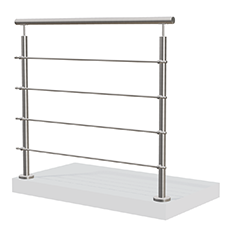
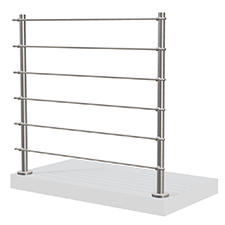
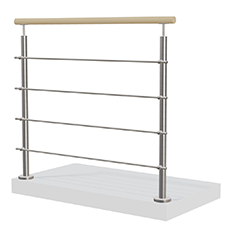
See how others have designed their stair balustrades, glass balustrades for terraces and frameless balustrades for balconies. Find inspiration in modern, classic and discreet solutions, each with its own character.
Browse our frequently asked questions and answers, or contact one of our specialists, who are happy to help.
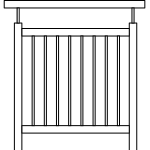
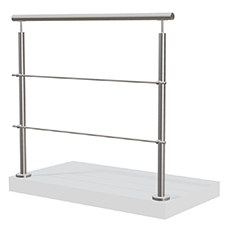
The main differences are appearance, sightlines and how easy the balustrade is to climb. Horizontal bars create long, contemporary lines, whereas vertical bars give a more traditional pattern without the same step-like arrangement. Horizontal bars can provide footholds and may be easier to climb.
Where young children may be present and the balustrade protects against falls, vertical bars are often the more suitable choice. On a ground-level patio, where the balustrade mainly defines the space, horizontal bars can be an attractive design option. Both aluminium and stainless steel balustrades are available with bar infill.
For outdoor stainless steel balustrades, marine-grade stainless steel, AISI 316L, is often a better choice, particularly near the coast and in other exposed environments. Its molybdenum content improves resistance to salt and chlorides. AISI 304 can be suitable indoors and in sheltered outdoor settings.
Stainless steel is not completely maintenance-free. Even a balustrade made from 316L can develop deposits or surface staining if salt, dirt and metal particles are left on it for long periods, so clean it as needed. Surface finish also matters: a smooth, well-finished surface is easier to keep clean. Choose the steel grade for the location and environment, not just its appearance.
Yes, stainless steel can develop rust-coloured spots and discolouration despite its name. Often, these are caused by airborne iron particles settling on the surface and corroding. Small brown marks do not necessarily mean that the stainless steel itself is corroding.
Salt deposits, accumulated dirt and cleaning with steel wool can also cause discolouration. Stainless steel has a protective surface layer that can reform when the surface is kept clean, so clean as needed and remove marks promptly. In coastal areas, AISI 316 or 316L stainless steel is often used. Stainless steel resists corrosion but is not completely immune to it.
Clean a stainless steel balustrade with lukewarm water, a mild detergent and a soft cloth or sponge, then rinse with clean water. Avoid steel wool, metal brushes and abrasive cleaners, which can scratch the surface or leave iron particles that cause discolouration. Cleaning frequency depends on the environment.
In sheltered locations, cleaning when the balustrade looks dirty is often sufficient, while installations near the sea or busy roads may need more frequent washing. Clean brushed steel in the direction of the grain and wipe down visible surfaces afterwards. Small brown spots are often caused by airborne iron particles from the surrounding environment rather than corrosion of the balustrade itself.
Yes, stainless steel balustrades are often used in public spaces, but the complete system must be designed for the loads and conditions of its intended location. Being made of stainless steel does not automatically make a balustrade suitable for every setting. Typical applications include stairwells, entrances, offices, shops, restaurants and access balconies.
Where large numbers of people gather, loading requirements may be higher than in a home. Posts, fixings, infill and the supporting structure therefore need to be designed as a complete system. For outdoor installations, choose a steel grade suited to the environment. For larger projects, establish the requirements before ordering.
Your shopping cart will be emptied if you switch to a different country.
Flow is a railing made of stainless steel that can be customised with your choice of height, number of rails, mounting type, and top rail —depending on where and how you want to use it.
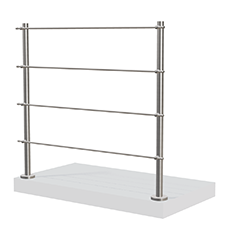
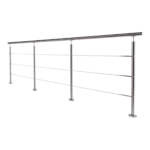
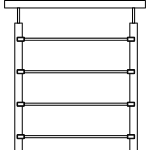
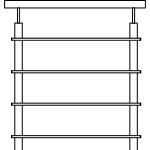
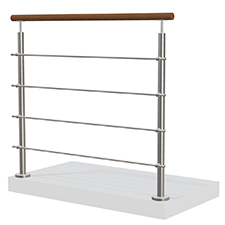
Flow is a railing made of acid-resistant stainless steel (AISI 316L) with horizontal round bars—designed for those who want a discreet yet functional frame. The horizontal bars create an open and airy look, while clearly defining the boundaries around patios, walkways, or timber decking.
The structure is made entirely of stainless steel and is designed for long-term use in harsh environments—year-round.
Flow is primarily used at ground level, where sightlines are important but you still need to define boundaries. Examples include:
Precisely because the Flow features horizontal bars, it is best suited for areas where there is no risk of falling. In areas with elevation changes or where children are present, we recommend other railings with anti-climb protection.
Installing Flow is easy—even for those with no prior experience. The system comes complete with all parts cut to size, pre-drilled, and ready to assemble. No welding or special equipment is required.
Here's how to do it:
Fixing For Flow, select directly from our design tool. Specify the surface you'll be installing it on—for example:
The appropriate screws and accessories are supplied according to your selected configuration and installation surface. Posts are top-mounted and pre-drilled for straightforward installation.
Once you've placed your order, you'll have access to our installation videos that show you exactly how to proceed—step by step, based on your selections.
Flow are manufactured at our production facility in Ängelholm. By designing and manufacturing our products in-house, we have full control over quality, strength, and the safety requirements that apply to railings in exposed environments. Each order is customised according to your specifications and comes with a declaration of performance.
Our production is certified in accordance with EN 1090-1 and complies with the applicable Eurocodes for load-bearing aluminium construction products and components made of stainless steel. It is continuously audited by RISE (Research Institutes of Sweden), which is responsible for external verification of traceability and processes.
In addition, we conduct our own load and impact tests to ensure that every railing functions as intended – regardless of where it is installed. Flow is designed for both indoor and outdoor use, in both private and public settings.
Here you'll find technical information about Flow – our railing in acid-resistant stainless steel with vertical bars. We’ve compiled data on dimensions, fixings, and installation principles to help you plan and compare options.
All files are available for download as PDFs and will help you prepare your order or complete a safe and proper installation.
Load-tested posts
The posts have been tested with top-mounted fixings on timber substrates and can withstand a load of 0.5–1.0 kN/m.
Round profiles, Ø 42 mm
Round posts made of stainless steel with a diameter of 42 mm. For indoor use: AISI 304 and for outdoor use: AISI 316.
stainless steel AISI 304 or 316 steel
If your railing is installed indoors, use the version available at, which is designated. If, on the other hand, it is to be installed outdoors, use AISI 316 instead, which is steel. stainless stainless posts AISI 304 acid-resistant stainless steel
Material thickness 2 mm
Round profiles, Ø 12 mm
Round, horizontal bars made of acid-resistant stainless steel (AISI 316) with a diameter of 12 mm. Material thickness 1.5 mm.
Round profiles, Ø 12 mm
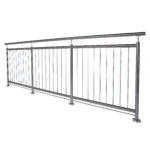
Round vertical bars made of acid-resistant stainless steel stainless steel (AISI 316) with a diameter of 12 mm.
Stainless top rail
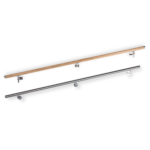
Round top rail in stainless steel (Ø 42 mm). AISI 304 for indoor use and AISI 316 for outdoor use. Fittings are included for any corners.
Timber top rail
Round top rail (Ø 43 mm) in untreated light oak or jatoba (a hardwood with properties and an appearance similar to teak).
Angles
If there are any corners on the railing, adjust the wooden crossbar yourself. This ensures a precise fit. For stainless top rail at angles greater than 90 degrees, corner brackets are included.
Symmetrical Sections
When you enter your measurements in our configurator, you always specify the edge dimensions at the location where you want the railing installed. Our configurator then makes the necessary adjustments. For your railing, we then adjust the section dimensions so that each section on either side is the same length. In other words, we customise the railing to fit your measurements—not the other way around.
Choice of balustrade height
In the configurator, choose a height from 800 to 1,100 mm, measured from the floor to the top of the balustrade. Check the appropriate height for your installation against the relevant local requirements, particularly where there is a fall risk.
Made to the millimetre
When you provide your measurements, please be as precise as possible—down to the millimetre. We’ll craft your railing to the millimetre so that it fits perfectly in the spot where you want to install it.
Top mounting
The base is secured to the floor with 4 screws.
Top rail with or without wall fixing
If the balustrade meets a wall, you can also choose to fix the top rail to the wall. This can make the structure slightly more stable.
Screw for timber fixing
If you choose to fix into timber, screws are included for this purpose. The screw is made of hardened steel and, for outdoor use, is also surface-treated with Corrseal—Corrosion Class C4. The screw features a milled groove along the shank and one at the tip. This results in a very low screw-in torque in harder wood and minimizes cracking.
Screw for concrete fixing
If you choose to fix into concrete, screws for this purpose are included. The screw is made of hardened steel and, for outdoor use, is also surface-treated with Corrseal—Corrosivity Class C4. Approved for use in cracked concrete, uncracked concrete, and hollow-core slabs. Also suitable for solid brick, hollow brick, solid Mexi brick, and natural stone. For fixing in materials other than wood or concrete, we recommend contacting your local hardware store.
Complete kit
Our shipment includes everything you need for assembly. In addition to posts, hinges, and top rail, it also includes all screws, drill bits, and any special tools required. If you have a screwdriver, a wrench, a folding rule, and a spirit level, you really don’t need anything else.
Assembly Videos and Instructions
The videos show various steps to help you with your assembly. Our assembly tips and videos are customised for each order. In other words, these are not general descriptions but are tailored specifically to your order.
Stainless Steel Components
Since stainless steel, despite its name, is not corrosion-resistant, all stainless components must be maintained and cleaned 1–3 times a year. If the railing is installed in a coastal environment, cleaning and treatment may need to be performed more frequently. Clean the surfaces with lukewarm water and a mild detergent using a soft cloth.
Timber top rail
If the railing is to be installed outdoors, we recommend cleaning the top rail and then sanding it with fine-grit sandpaper. Treat top rail with a wood preservative such as wood oil or similar, depending on the prevailing conditions. For indoor installation, only cleaning and light sanding are required. Treatment with wood oil or similar can be done if desired. All oak contains tannic acid in varying amounts, depending on the wood’s moisture content. This is because tannic acid prevents the wood from rotting. When your oaktop rail or handrail is exposed to moisture for the first time in an outdoor environment, tannic acid is released, which can cause discoloration on the surface it rests on. Therefore, we recommend oiling the wood or, alternatively, applying oxalic acid during installation to reduce the release of tannic acid. Oxalic acid can also be used to clean up discoloration on the surface. Consult your paint supplier before using oxalic acid. To keep the wood looking its best, we also recommend oiling it once a year.
Our A+, A, B and C use classes provide guidance on where a particular balustrade configuration may be suitable. They draw on our product testing and take into account factors such as the chosen height, section width and components. These are our own product classifications, not UK building regulation categories. The installation must also meet the requirements that apply at its location.
Use class A+
Our A+ configuration is documented for a minimum horizontal line load of 1 kN/m. The suitability of a particular balustrade for a residential, commercial or public setting depends on the complete configuration and the requirements of the installation site. Where glass is included, the specified safety glazing should be assessed as part of the whole system.
Use class A
Our A configuration is documented for a minimum horizontal line load of 0.5 kN/m. Whether that configuration is suitable for a particular residential installation depends on the site and its applicable requirements. Where glass is included, the specified safety glazing forms part of the overall system.
Class B
Class B railings are suitable for use in environments where the height difference between the floor and the ground is 0.5–3 metres. Our Class B railings can withstand a minimum linear load of 0.5 kN/m, and when the railing includes glass, this acts as a “ safety glass ” that prevents injury in the event of an impact.
Class C
Class C railings are suitable for use at ground level. If the railing includes glass, it is a “ safety glass ” that prevents personal injury in the event of an impact. A balustrade may also be classified as Class C if Balustradedesign, in consultation with you as the customer, makes a modification to the railing that deviates from our standard. In this case, the Class C classification indicates that this specific configuration has not been tested.