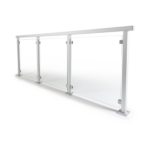
When is fall protection needed and what should a balustrade provide? Explore height, child safety, glass, loads and fixings for decking, balconies, stairs and other locations.
See how others have designed their stair balustrades, glass balustrades for terraces and frameless balustrades for balconies. Find inspiration in modern, classic and discreet solutions, each with its own character.
Our online design tool helps you plan the appearance and cost.
Our balustrades are designed for self-installation and are supplied with installation instructions. Our team can offer advice to help you plan your project.
On a dock, the railing needs to withstand moisture, water splashes, and—on the coast—salt. Aluminium and acid-resistant stainless steel are common choices, with glass or wire as the infill, depending on how much windbreak and a view you want. The right material ensures that the railing stays attractive for a long time.
Powder-coated Aluminium is lightweight and durable, and stainless steel AISI 316 stainless steel gives a maritime look and resists salt. Wire preserves the view, while glass reduces wind and splashes. Screws and hardware must be able to withstand the same environment as the railing to prevent corrosion between different metals. For a floating dock, the dock’s movement and load must be taken into account during the planning phase.
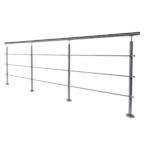
A wire balustrade consists of tensioned wires between posts, creating an open design that takes up little visual space. The wires are made from corrosion-resistant AISI 316 stainless steel and held taut using fixings and adjustable tensioners. The tension can be adjusted during installation and later if needed.
Wire balustrades suit decking, jetties and stairs where you want an open appearance. On staircases, the wires and fixings are adapted to the slope. Maintenance is straightforward: wipe the wires as needed and periodically check the wires, fixings and tensioners. Remember that horizontal wires may be easy for young children to climb.
Yes, stainless steel can develop rust-coloured spots and discolouration despite its name. Often, these are caused by airborne iron particles settling on the surface and corroding. Small brown marks do not necessarily mean that the stainless steel itself is corroding.
Salt deposits, accumulated dirt and cleaning with steel wool can also cause discolouration. Stainless steel has a protective surface layer that can reform when the surface is kept clean, so clean as needed and remove marks promptly. In coastal areas, AISI 316 or 316L stainless steel is often used. Stainless steel resists corrosion but is not completely immune to it.
A balustrade can be installed on a variety of surfaces, but fixing must always be anchored to a stable, load-bearing structure—not just to the material visible on the surface. The correct fixing depends on the surface, balustrade system, and the structure’s design. On wooden and composite decking boards surfaces, posts must be anchored to the load-bearing joists beneath the boards.
Concrete and solid stone may provide suitable fixing points if their condition and load capacity are confirmed. Brick and lightweight concrete need anchors designed for the specific substrate. Avoid loose paving slabs, weak joints and unsuitable edge distances.
The stability of a glass windbreak depends on the glass, posts, fittings and fixings being designed for the wind loads at the site. The whole structure matters, not just the thickness of the glass. Thicker glazing alone cannot compensate for inadequate supports or fixings.
A tall windbreak on an exposed balcony or terrace is subject to greater wind forces than a lower screen in a sheltered position. Its fixings must therefore be anchored to a load-bearing structure, as decking boards, paving slabs and other surface finishes may not be sufficient. If the screen moves or vibrates noticeably in strong winds, check the fixings, posts and brackets.
A jetty or waterside deck can be one of the most exposed parts of a property. Wind, moisture and salt can affect materials that are not suited to the conditions. A well-designed balustrade can define the edge without blocking the view.
Tenso combines corrosion-resistant stainless steel posts with tensioned wires for an airy, nautical look. For an uninterrupted view, frameless Vista uses glass held in an aluminium base channel along the edge. Prime offers a more defined appearance with stainless steel posts.
For waterfront settings, corrosion-resistant stainless steel is a common choice. The molybdenum in suitable alloys improves resistance to chloride exposure compared with some other stainless steel grades, although regular cleaning is still needed. Explore stainless steel balustrades, including bar systems such as Flow and Breeze.
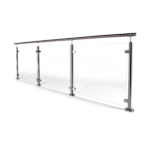
Glass preserves views while offering some shelter from wind. Depending on the product, we use toughened and laminated safety glass; the interlayer helps retain fragments if breakage occurs.
A timber jetty needs different fixings from concrete or stone. The design must account for the substrate, supporting structure and wind exposure beside the water. Orders are supplied with installation guidance for the chosen configuration. Plan any lighting near the jetty edge before installing the balustrade.
Rinse balustrade components with fresh water as needed to remove salt deposits and clean glass with a suitable glass cleaner. The manufacturing process is certified in accordance with EN 1090-1. RISE regularly monitors production with a focus on traceability, quality and manufacturing processes.
Your basket will be emptied if you change country.