

The right lighting allows you to use your patio longer into the evening. When daylight fades, lighting along the railing can both set the mood and make it clearer where the patio ends.
It is particularly useful along edges, on stairs, and at other changes in level, where light can help the eye perceive the surroundings more clearly.
This article focuses on how LED lights, solar-powered lights, and other outdoor lighting options can be combined with various railing solutions. The lighting fixtures themselves are not included in our product line, and any wiring or electrical installations must be planned and handled separately.
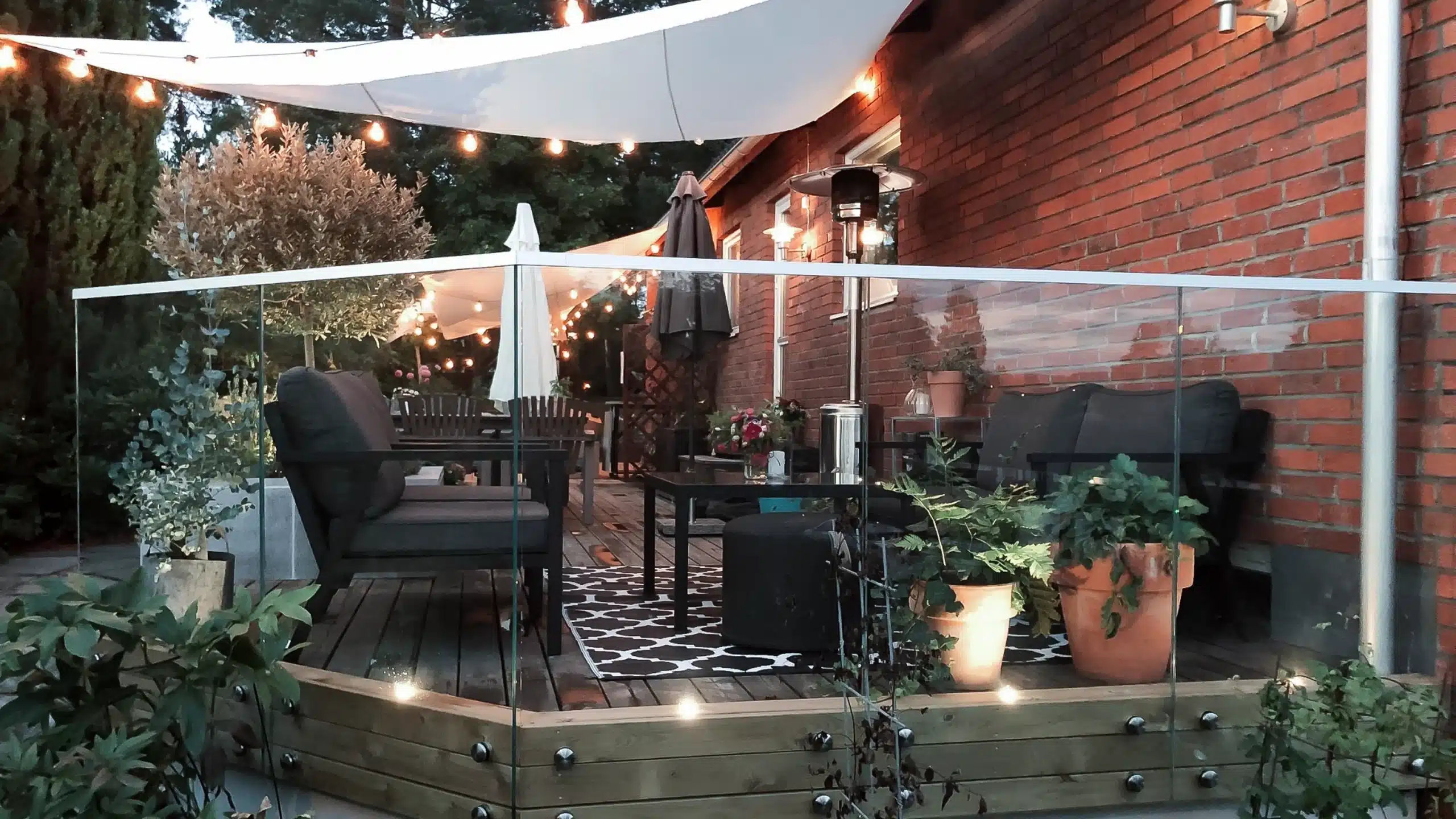
Does the lighting need to be planned before the balustrade is ordered?
Yes, if you want wired lighting along the railing, it’s a good idea to plan the placement, cable routing, and electrical installation early on. Balustradedesign does not provide cable feed-throughs in posts or profiles, so cable routing and fixings need to be handled separately from the railing itself.
LEDs and other wired lighting
Decide early on where the light will be located and how the cable can be routed without relying on cable glands in the rail’s posts or profiles. The transformer, cable routing, fixing, and any permanent electrical installation must be planned as a separate part of the project.
Solar-Powered lights
Solar-powered lights do not require any wiring and can therefore be added after the railing has been installed. They are easy to reposition, but typically provide less light and more variable illumination than a wired solution.
Plan wired lighting as a separate installation alongside the balustrade. If you want to add lights later without running cables, solar-powered lights are the simplest option.
When is an LED strip a good choice for lighting an outdoor balustrade?
LED strips are best suited when you want even lighting along the railing without individual light sources dominating the scene. They can be installed alongside the top rail and used for both ambiance and wayfinding.
Choose warm-toned lighting
Most LED strip lights are dimmable and come in several colour temperatures. Warm white, around 2,700 to 3,000 kelvin, usually creates the softest ambiance outdoors. Cooler light can easily feel sterile in a garden, even when the installation is otherwise done correctly.
Adjust the IP rating based on the location
Select the protection rating based on how exposed the lighting is to rain, moisture, and other water-related factors. In more exposed outdoor locations, a higher IP rating may be required than in a sheltered location. Near a pool and in other locations particularly exposed to water, you need to check the requirements that apply to the specific installation.
Do solar-powered balustrade lights work outdoors year-round?
Yes, but brightness and runtime vary significantly throughout the year. Solar-powered lights charge during the day and turn on at dusk, making them easy to add without any wiring. They’re best suited for creating ambience and helping you find your way, not for lighting up an entire patio.
Several cloudy days in a row also affect the operating time, since the battery does not have time to fully charge between evenings.
| Period | Operating time | What affects it? |
|---|---|---|
| Summer | 6–10 hours on a full charge | Longer days provide a better opportunity to recharge the battery. |
| Winter | Can be roughly halved | Shorter days mean less time for charging. |
A solar-powered light that is in the shade for most of the day will have a harder time charging its battery. Therefore, check where the sun actually hits the railing before deciding on its placement.
When is a recessed spotlight appropriate for a balustrade?
Recessed spotlights are ideal when you want to direct light towards, for example, the floor, an edge, or a stair tread without the fixture protruding. This solution requires more planning than surface-mounted lighting, since the fixture, wiring, and any drilling must be handled separately from the railing itself.
Lights along the balustrade
A light fixture mounted on the side of the post can direct light downward towards the floor, the edge, or nearby steps. Always check that the chosen solution is suitable for the railing’s design before drilling any holes.
Light from above
A light source from above can provide a concentrated beam of light directed downward towards the surface closest to the railing. Here, too, the fixture’s placement and fixing must be adapted to the specific railing design.
Check this before choosing a recessed spotlight
Recessed lighting must be planned as a separate installation. Start by determining the placement, and then ensure that the fixture, fixing, and wiring work in conjunction with the railing.
-
Determine the location
Start by determining which surface the light should hit, and direct it downward so that the floor, edge, or stair step is clearly visible.
-
Check the fixing
Before starting work, check that the light fitting and any proposed holes are suitable for the particular balustrade construction.
-
Plan the cable route separately
Plan how the cable will reach the lights without assuming that the balustrade posts or profiles have openings for cables.
What electrical and IP rating considerations apply to outdoor balustrade lighting?
Outdoor lights need to suit both the electrical installation and the amount of moisture and water they will be exposed to. First, distinguish connections on the low-voltage side of the transformer from work on the fixed electrical installation.
Follow the system's instructions
In pre-assembled low-voltage systems, certain connections on the side after the transformer can be made without modifying the fixed electrical installation. Always follow the manufacturer’s instructions and do not make any changes to the permanent installation unless you have the proper qualifications and are authorized to perform the work in accordance with the regulations in the location where the installation is being carried out.
Check the electrical installation requirements
Any permanent connection of lighting or a transformer to the fixed electrical installation must comply with the requirements in the place where the work is carried out. Use a suitably qualified professional where required.
Choose an IP rating based on how exposed the location is
The more a light fitting is exposed to rain, water from cleaning or other sources of water, the more important its level of protection becomes. Always check that the product is suitable for the installation location. Additional electrical requirements may apply near a pool.
Sheltered position
May be suitable for lights in more sheltered positions where they are not exposed to heavy water spray.
More exposed locations
Provides greater protection for fittings that are more directly exposed to the weather and water.
High exposure to water
For products designed to withstand significantly greater exposure to water.
Choose a replaceable LED module where possible
In that case, the light source can be replaced when it has reached the end of its service life. With a permanently soldered-in LED, the entire fixture often needs to be replaced.
LEDs are usually a better choice than halogen
LEDs use significantly less energy and have a longer lifespan. For railing lighting, there is rarely any practical advantage to choosing halogen.
Regulations for permanent electrical installations and installations in particularly harsh environments may vary from market to market. Therefore, always check the applicable regulations in the location where the lighting is to be installed.
How should lighting be positioned on stairs or where levels change?
Direct the light so that the front edge of the steps and the transition between different levels are clearly visible. When there is a staircase balustrade, it is more important to highlight where the height changes than to try to illuminate the entire staircase evenly.
Highlight the edge – not the entire staircase
Downward-directed light from a properly positioned light fixture makes the step nosing more visible. It is especially the transition between two levels that the eye needs to be able to perceive so that the foot lands in the right place.
On the stairs, the light is directed towards the front edge of the steps so that the different levels are easier to distinguish.
When there is a difference in level, the light should indicate where the floor, deck, or ground changes in height.
How do you plan outdoor balustrade lighting?
Start by deciding on the location and how the light will be used. Next, choose the light source, colour temperature, and protection rating, and finally, plan the electrical installation.
-
Decide what you want the light to help you with
Decide whether the lighting should primarily set the mood, highlight an edge, or make steps and changes in level easier to see.
-
Plan the layout and cable routing
For wired lighting, you need to decide early on where the fixtures will be placed and how the cable will be routed without assuming that there will be cable openings in the balustrade posts or profiles.
-
Choose the right type of lighting
LED strips provide even lighting, solar-powered lights are the easiest to add later, and spotlights suit areas where you need to direct the light towards a specific point.
-
Choose a colour temperature that suits your outdoor space
Warm white, around 2,700–3,000 kelvin, typically provides a softer and more pleasant light outdoors.
-
Check the IP rating
Select the luminaire's protection rating based on how exposed the location is to rain, moisture, and other water-related factors.
-
Point the light downward
Let the light highlight the floor, edges and steps instead of shining directly on anyone sitting on the patio or walking by.
-
Plan the 230-volt installation
If lighting or a transformer needs to be connected to the fixed electrical installation, the work must meet the electrical requirements that apply locally. Use a suitably qualified professional where required.
Start with the function and location, then select the right light and IP rating, and handle the wiring and electrical installation as a separate part of the project.
Choosing a balustrade for a patio with lighting?
Start by choosing a balustrade that suits the space, then plan the lighting, cabling and electrical installation separately. We do not sell lighting, but our balustrades are made to measure.
What should you know about lighting along a balustrade?
Here are some brief answers about outdoor lighting, IP ratings, colour temperature, solar cells, electrical installations, and smart controls for railings.
Do you sell balustrade lighting?
No, we do not sell balustrade lighting. Light fittings, cable routes and any electrical work need to be arranged separately.
What IP rating is required for outdoor balustrade lighting?
The IP rating must be selected based on how much the fixture is exposed to moisture and water. IP44 may be suitable for more sheltered locations, while IP65 or higher may be required in more exposed environments. Additionally, special requirements may apply to the electrical installation near swimming pools and other locations particularly exposed to water.
Can I install balustrade lights myself?
In pre-assembled low-voltage systems, certain connections on the side after the transformer can be made without modifying the fixed electrical system, provided the manufacturer’s instructions allow it. Work involving the fixed electrical system must comply with the electrical codes in effect where the installation is being performed. Hire a qualified professional when the work requires it.
What colour temperature is best for an outdoor railing?
Warm white, around 2,700 to 3,000 kelvin, is often a good choice for a patio because it provides a softer light. Cooler light can feel more sterile outdoors.
Do solar-powered lights on balustrades work year-round?
Yes, but brightness and runtime vary throughout the year. During periods with many hours of daylight, the battery has more time to charge, while shorter days and several cloudy days in a row can result in significantly shorter runtime.
Can lighting be added to a balustrade at a later date?
Yes, solar-powered lights, in particular, are easy to add later on because they don’t require any wiring. Wired LED lights and spotlights require more planning because the cable routing, fixing, and any electrical installation must be addressed separately.
Can rail lighting be controlled by a timer or a dusk sensor?
Yes, many lighting solutions can be combined with, for example, a timer, a dusk sensor, a motion sensor, or other compatible control systems. Make sure the control system is designed for the specific lighting and outdoor environment.
Does lighting on a staircase count as fall protection?
No. Lighting can make stairs and changes in level easier to see and use, but it does not replace a balustrade or other form of fall protection.

