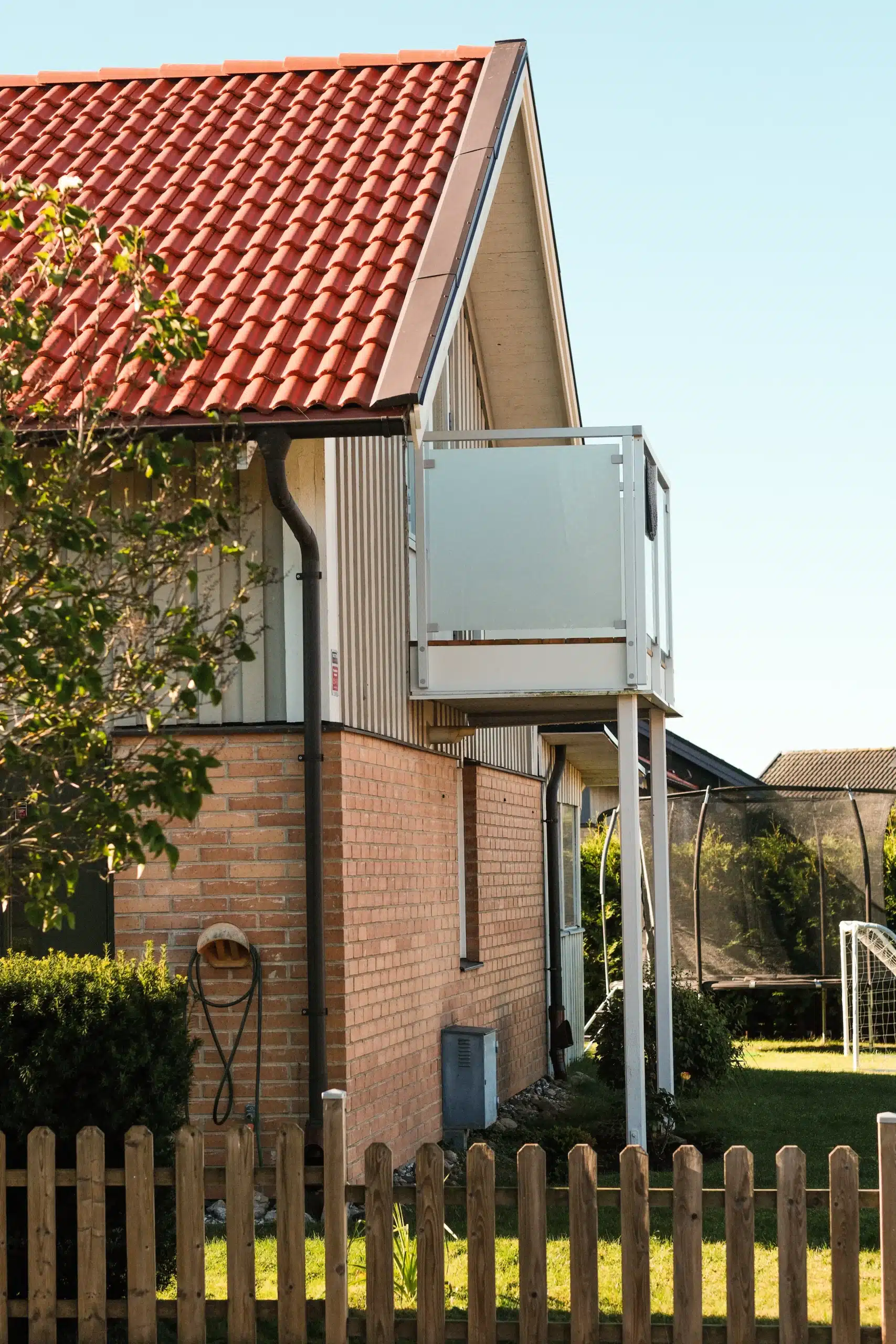
A frameless glass balustrade functions without load-bearing posts between the glass panes. Instead, the load is transferred through the glass down to the rail or point fasteners and on to the load-bearing substrate.
That is the main difference from a glass balustrade with posts, where the posts take a substantial share of the load. Without posts, the glass, fixings and supporting structure must work together to carry the loads.
The result is a railing with unobstructed sightlines and very little visible structure. Balustradedesign’s post-free solution Vista is based on that principle, and in this article we’ll go over how the design works, what requirements it entails, and when a frameless glass balustrade might be worth the extra cost.
How is the load transferred in a frameless glass balustrade?
In a frameless glass balustrade, loads are transferred through the glass to the base channel or point fixings and onwards into the supporting structure. In a post-supported balustrade, the posts carry a substantial share of those loads.
The structure of the glass, fixing, and the substrate must therefore work together. Thicker glass will not solve the structural problem if fixing lacks a sufficiently load-bearing substrate. Concrete or a sturdy, properly placed wooden stud can provide the right conditions, while deck boards, drywall, thin tiles of unknown quality, or a masonry coping must be evaluated based on the load-bearing structure behind them.
The post supports the load
If someone pushes against the top of the railing, the force is transferred to the nearest post and then through the post base to the supporting structure.
The glass transfers the load to the fixings
Without posts, forces are transferred through the glass panel to the base channel or point fixings and then into the load-bearing structure.
What type of glass is used in the Vista frameless glass balustrade?
Vista uses 12.76 mm toughened laminated glass, comprising two 6 mm glass panes with an interlayer. Without posts, the glass plays a greater structural role than in many glass balustrades with posts, because loads need to pass through the glass to the fixings.
The glass transfers the load to the fixings
When there are no posts to absorb the force, the glass panel must transfer the load down to the track or the point fixings.
Two glass panes with an interlayer
Vista glass comprises two 6 mm panes with an interlayer, giving a total nominal thickness of 12.76 mm.
The lamination holds the glass together
If one of the panes breaks, the interlayer helps retain the fragments rather than immediately leaving an open gap.
How is the glass attached to a frameless glass balustrade?
Two common fixing methods for frameless glass are a continuous aluminium base channel and separate point fixings, such as Fixpoint. Both avoid vertical posts, but transfer loads into the supporting structure in different ways. Vista can also be fitted using floor fixings.
With a base channel, plan its position early so that the fixings can be anchored to the load-bearing structure rather than just the finished surface.
| Fixing | Here's how it works | Suitable for |
|---|---|---|
| Aluminium base channel | A continuous channel is anchored to the supporting structure, such as concrete or a suitably designed timber member. The glass is positioned in the channel and secured with wedges. Depending on the system, the channel can be fitted on top of or to the outside of the structure. | Long, straight runs and corners. Loads are transferred along the channel’s fixings rather than through a small number of individual points. |
| Fixpoint | The glass is held in place by separate point fixings made of stainless steel that are mounted on the outside of the load-bearing structure. The load is supported at the individual attachment points. | When the glass is to be installed on the outside of the structure and the floor surface is to be left unobstructed, without a continuous aluminium rail. |
What colours are available for the frameless balustrade base channel?
The Vista channel comes in four standard finishes: natural anodised, textured grey, black RAL 9005 and white RAL 9010. Beyond these standard finishes, the channel can be powder-coated in over 200 RAL colours to match window frames, doors or other metal details.
Natural anodising and powder coating are different surface treatments. The natural anodised channel has a silver-coloured finish. Vista’s technical product information specifies an anodised layer of 20 micrometres. Anodising enhances aluminium’s natural oxide layer, while powder coating provides the coloured finish.
Four standard finishes
Natural anodised
SilvertonTextured grey
Darker shadeBlack
RAL 9005White
RAL 9010Does a frameless glass balustrade need a top rail?
No. A frameless glass balustrade can have an exposed glass edge or be complemented with a top rail made of aluminium, wood, or stainless steel. The choice primarily affects the appearance, the grip, and how well the glass edge is protected. Vista offers all three material options.
Exposed glass edge
It provides the cleanest and most minimalist look because no profile interrupts the upper line of sight through the glass. It’s ideal when a frameless look and as little visible structure as possible are the top priorities.
Aluminium, wood, or stainless steel
Vista’s aluminium top rail is a 20 × 30 mm U-shaped profile bonded to the glass and can be matched to the channel colour. A round stainless steel top rail measuring 42.4 mm, secured with a rubber insert, is also available, as are 45 mm-wide top rails in light oak or teak bonded to the glass. They differ in appearance, feel and the protection they provide to the glass edge.
When is a frameless glass balustrade worth the extra cost?
A frameless glass balustrade is especially worthwhile when a clear view is central to the setting. The more important the view or sense of openness, the greater the visual benefit of removing posts.
A frameless system typically costs more than a comparable glass balustrade with posts. The additional cost can reflect the glass specification and the structural fixings required to transfer loads without posts.
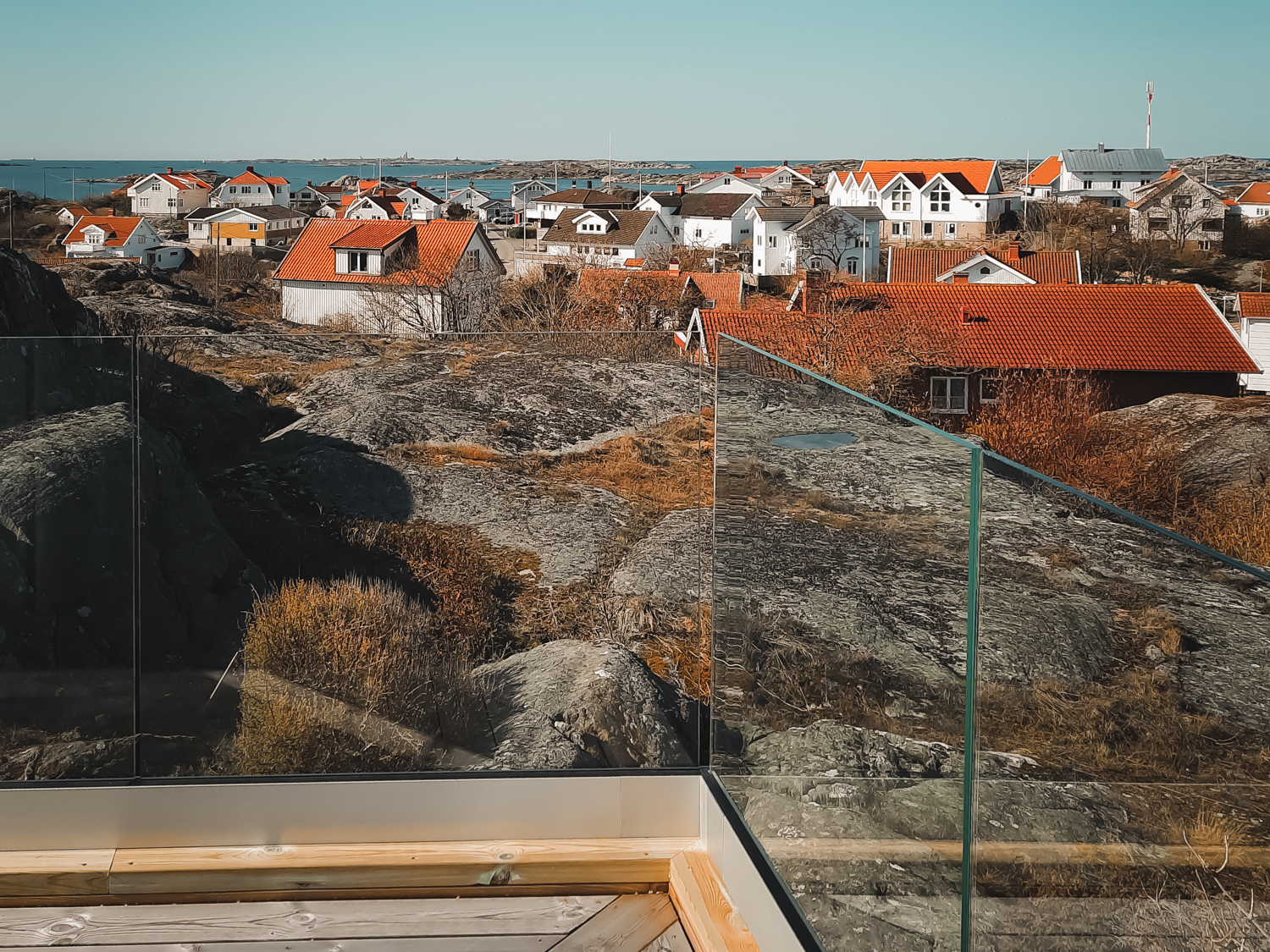
The view is the whole point
Whether overlooking water, open countryside or a valley, or installed on a roof terrace, posts can interrupt the view you want to preserve. That is where a frameless design can make the biggest difference.
The area is small
On small balconies, lofts, and terraces, posts can visually divide an already limited space. Clear glass without posts makes the room feel more open.
Privacy-screened deck
If the railing is placed against a hedge, a solid privacy screen or a nearby building, an unobstructed line of sight is less important. In such cases, a post-supported glass balustrade with narrow profiles can provide a similar overall appearance at a lower cost.
What should you check before choosing a frameless glass balustrade?
Start with the supporting structure, then check the dimensions, height, fixings and top edge. A frameless glass balustrade needs careful planning before the glass and fixings are selected.
Check before ordering
Six things to consider before choosing a railing
-
What should fixing be based on?
Inspect the full length where the channel or point fixings will be installed. Concrete or a suitably designed load-bearing timber member may provide an appropriate fixing surface; decking boards, plasterboard and other finishes cannot serve as structural fixings by themselves. If the structure is unknown, have it assessed before ordering.
-
Have you measured each section and marked the corners?
Measure each straight section separately and note where the rail changes direction. The placement of the corners affects both the glass panels and the design of the track or point fixings.
-
What should the height of the balustrade be?
The balustrade height affects both the design and the loads on the glass and fixings. Establish the required height before the system is finally specified.
-
Should the glass be mounted using a track or Fixpoint?
Aluminium tracks are particularly well-suited for longer straight sections and around corners. Point fixings can be an alternative for shorter sections or where fixing should be as inconspicuous as possible.
-
Would you prefer an exposed glass edge or a top rail?
A bare glass edge creates the most minimalist look. A narrow aluminium top rail, on the other hand, provides a more secure grip and protects the glass edge.
-
What are the requirements for the location where the balustrade will be installed?
The location, use, and the height of fall of the railing may affect which safety requirements apply. Therefore, check the current guidelines for the site before deciding on a solution.
Next step
Would a frameless glass balustrade look good on your patio or balcony?
Consider the foundation, the length of the railing, any corners, and how important an unobstructed view is. Once these factors are clear, it becomes easier to determine whether a frameless glass balustrade is the right solution for the location.
What should you know about frameless glass balustrades?
Here you'll find brief answers to common questions about glass thickness, mounting surfaces, fixing, top rail, cost, and when a frameless glass balustrade is the best choice.
How does a frameless glass balustrade work without posts?
The load is transferred through the glass down to an aluminium rail or separate point fixings and from there to the supporting structure. Therefore, the glass, fixing, and the substrate must work together.
How thick is the glass used in the Vista frameless glass balustrade?
Vista uses 12.76 mm toughened laminated glass, comprising two 6 mm panes with an interlayer. This is a Vista product specification, not a general glass-thickness requirement for every frameless balustrade.
Can you install a frameless glass balustrade on decking?
The decking boards are not a load-bearing surface in and of themselves. The fixing must be attached to a load-bearing structure behind or beneath the decking, such as a sturdy and properly positioned wooden joist.
What is the difference between an aluminium base channel and point fixings?
An aluminium base channel is continuous and transfers loads through its fixings along the run. With point fixings, the glass is held at separate fixing points, each transferring loads into the supporting structure.
Can a frameless glass balustrade be installed without a top rail?
Yes. A bare glass edge creates the most minimalist look. Vista can also be supplemented with a U-shaped aluminium profile measuring 20 × 30 millimeters, which provides a more secure grip and protects the glass edge.
Why does a frameless glass balustrade cost more than one with posts?
Frameless glass balustrades typically cost more because the system must transfer loads without load-bearing posts. The difference reflects factors such as glass specification and the fixings required for the frameless design.
When is a frameless glass balustrade most appropriate?
This works particularly well when the view is an important part of the space or in smaller areas where posts would otherwise obstruct the line of sight. If the railing is placed against, for example, a hedge or a solid screen, the visual difference is often less noticeable.