Reinforcing bars can create a distinct industrial look and serve as a decorative boundary, but when the structure is intended to be a railing and provide protection against falls, safety becomes the decisive factor. In that case, it is not enough for the bars to look sturdy or for the structure to feel stable.
Reinforcing steel is normally embedded in concrete, where the surrounding environment helps protect the steel from corrosion. When the steel is instead left untreated and exposed outdoors, it is directly exposed to rain, moisture, and air, while the entire railing structure must be evaluated based on its function as fall protection.
The article explains what happens when rebar is used as a railing, when it can work, and what alternatives offer a similar industrial look. Rebar is not included in Balustradedesign’s product line.
Why does rebar rust when it's used as a balustrade?
Reinforcing steel is normally intended to be embedded in concrete, where the alkaline environment helps protect the steel surface from corrosion. When the same steel is left untreated and exposed outdoors, the protective environment disappears, and the iron is directly exposed to moisture, rain, and air.
The concrete helps protect the steel
Concrete has a high pH. The alkaline environment allows a passivation layer to form on the steel surface, slowing down corrosion.
A protective environment around the steelThe protective environment no longer exists
When the rebar is exposed, one can no longer rely on the concrete's corrosion-inhibiting environment. Instead, the untreated steel surface is directly exposed to the elements and moisture.
Untreated steel is exposedRISE describes how the alkaline environment in concrete can provide reinforcing steel with a protective passivation layer. See their information on reinforcement corrosion in concrete.
What problems can rebar used as a balustrade cause in practice?
Reinforcing bars left untreated outdoors can cause rusty water and stains on the surface; the ribbed surface feels rough to the touch, and horizontal bars can make a safety barrier easier to climb. Therefore, it is not just corrosion that needs to be taken into account.
Rusty water can discolour the surface
When rain and moisture come into contact with untreated steel, rust-stained water can run off onto decking, concrete, or stone. On light-coloured and porous surfaces, such discolouration can be clearly visible.
The ribbed surface is rough
The ribs on the rebar are designed to improve anchorage in concrete. When the steel is instead left exposed in a railing, you get an uneven and significantly rougher surface than with profiles that are intended to be part of a finished balustrade system.
Horizontal steel bars can act as footholds
Horizontal bars can make it easier to climb a railing. In areas where young children are present, the design must therefore prevent climbing and comply with the requirements applicable to that specific location.
Always check the current guidelines from your municipality or the relevant authority.
When can rebar serve as a barrier?
Reinforcing bars can be used in decorative structures where there is no risk of falling, such as trellises, plant supports, or simple garden boundaries. However, when the structure is intended to prevent people from falling, it must be classified as a railing and dimensioned for that purpose.
| Situation | Assessment |
|---|---|
| Boundary in a garden without drop height |
Might work
The structure then serves as a marker or decoration, not as protection against falls. |
| Trellis or plant support |
A better fit
Here, the material's raw appearance and malleability can be used without the structure also having to serve as a railing. |
| Deck where the railing prevents falls |
Requires a different assessment
In that case, the entire railing structure, including fixings, and joints, must be evaluated for its safety function. |
| Balcony or staircase with a risk of falling |
Choose a railing solution
Fall protection is a key feature here. Therefore, start with a design intended to serve as a railing at the location in question. |
| Areas where young children may be present |
Avoid shapes that can be climbed on
Horizontal iron bars can serve as footholds and make it easier to climb the structure. |
A decorative barrier and a railing designed to prevent falls serve different purposes. The greater the safety role of the structure, the more important it becomes to be able to assess the overall design of the railing and fixing.
Which balustrade offers the same industrial look as rebar?
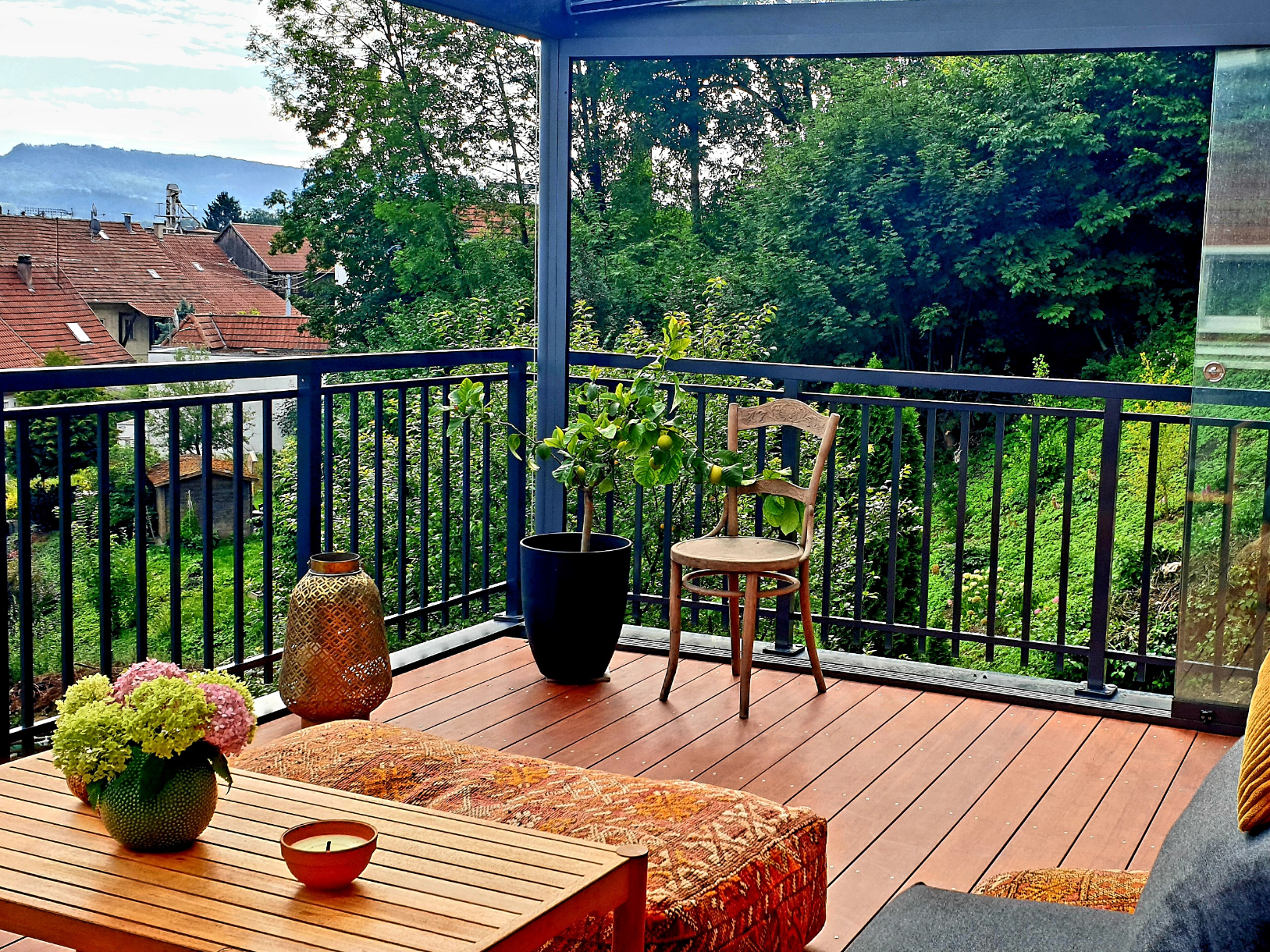
A wrought-iron-inspired railing with narrow vertical balusters and a matt black finish closely resembles the look that many people seek with rebar. The difference is that the structure is designed from the outset to serve as a railing, rather than using a building material for a different purpose.
Designed as a railing from the start
Posts, balusters and fixings are part of a single, integrated railing structure rather than being assembled from materials that are primarily intended for other purposes.
Matt black finish without a raw steel surface
The dark finish and narrow profiles preserve the industrial look without leaving the untreated reinforcing steel exposed to the elements and moisture.
Materials and fixings go hand in hand
When selecting a railing as a pre-fabricated structure, posts, balusters and fixings can be evaluated together for the location where the railing will be installed.
How do you determine whether rebar is the right choice for a balustrade?
Start with the structure’s function. If it is intended to provide protection against falls, the entire railing must be evaluated in terms of safety, fixing, and design. If, on the other hand, it is a decorative barrier with no risk of falling, there is greater freedom in the choice of materials.
Seven questions to help you evaluate the solution
-
Is the structure designed to prevent falls?
First, decide whether the structure is intended to prevent people from falling, or simply to mark a boundary, support plants, or create a certain look.
-
Can the entire balustrade structure be evaluated?
If the railing serves a safety function, the materials, dimensions, fixings, and joints must be evaluated together—not just the strength of the steel itself.
-
Is it just a decorative divider?
As a trellis, plant support, or simple barrier without a risk of falling, rebar may be more suitable, since the structure then does not need to serve the same function as a fall-protection barrier.
-
Will the structure be climbable?
Horizontal iron bars can serve as footholds. In areas where younger children may be present, the design must therefore be evaluated specifically with regard to the risk of climbing.
-
Can the surroundings withstand rust stains and discolouration?
Untreated steel can cause rust-stained water on decking, concrete, and stone. Therefore, assess both the ageing of the material and how the surfaces beneath the structure may be affected.
-
Is it mainly the industrial look you're after?
Slim profiles, vertical slats, and a matt black finish can create the same minimalist look without the structure having to be built from untreated rebar.
-
Are there any rules or other requirements to check?
Location, fall risk, the building’s design, and any changes to the facade may affect which requirements need to be verified before construction begins.
Reinforcing bars can be an expressive material in a decorative structure, but the more important the fall protection is, the more important it becomes to choose a solution that is designed and evaluated as a railing.
Do you want the same look – but a balustrade built for the job?
A matt black railing with narrow vertical balusters can create an industrial and minimalist look without the structure having to be made of untreated rebar. If you need help choosing a solution, customer service can assist you based on your location and desired look.
What do you need to know about using rebar as a balustrade?
Frequently asked questions include topics such as regulations, surface treatment, and when rebar can be used without the structure also having to serve as fall protection.
Is it illegal to use rebar as a balustrade?
It is not the material name itself that determines whether a structure functions as a railing. If the structure is intended to protect against falls, the entire railing—including its dimensions, fixings, and design— must meet the requirements applicable to the location.
Does rebar need to be surface-treated if it is used outdoors?
Untreated reinforcing steel is deprived of the concrete’s protective alkaline environment when used exposed outdoors and can therefore begin to corrode. To protect the steel surface, a surface treatment that is suitable for the specific outdoor environment must be selected and maintained.
Can rebar be used as a boundary at ground level?
Yes, as a decorative barrier in a location where there is no risk of falling, rebar can work. In that case, the structure does not serve the same safety function as a railing designed to prevent people from falling.
Can rebar be used as a trellis or plant support?
Yes. When used as a trellis or plant support, the material’s raw appearance and malleability can be useful, since the structure then does not need to serve as a fall-protection railing at the same time.
Which balustrade is best if you want an industrial look?
A railing with narrow vertical balusters, few decorative details, and a matt black finish can create a similar industrial look without the structure having to be made of untreated rebar.