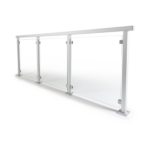
A made-to-measure glass balustrade is manufactured to suit the dimensions and conditions of the installation site, so it can follow the layout of a deck, balcony or staircase.
A deviation of just a few centimetres, on the other hand, can be immediately noticeable. The glass has no seams to hide the deviation, and a gap against the façade or the substrate easily draws the eye.
Toughened glass cannot be cut to size on site. Instead, a piece of glass that is too large must be remanufactured. That’s why we’ll walk you through how to measure, what factors affect the dimensions, and what needs to be determined before placing an order.
What does a made-to-measure glass balustrade mean?
A made-to-measure glass balustrade is manufactured to the specified measurements for the installation site rather than to fixed, standard section lengths.
This means that the glass dimensions must be correct before manufacturing begins. Some aluminium profiles can be adjusted in length during installation, but this depends on balustrade system and the specific part in question. However, the glass dimensions and finishes cannot be adjusted in the same way after tempering.
How do you measure for a made-to-measure glass balustrade?
Measure each section of railing separately and check the surface at several points. When measuring for a glass balustrade, even small deviations in the façade, decking, and corners must be taken into account, since they are rarely visible until the measurements are compared.
Seven things to check when taking measurements
-
Measure each side separately
Measure from corner to corner. Never just give the total length around the entire railing.
-
Take measurements at three points
Check the measurement at the beginning, middle and end of each side. The supporting surface may be less straight than it looks.
-
Enter the minimum measurement
If the three measurements differ, enter the smallest one. The glass must fit at its narrowest point.
-
Check that the walls and posts are plumb
Check the façade and any existing posts with a spirit level. Note if anything is out of plumb.
-
Check the corner angles
Measure the angle if a corner doesn't look perfectly right-angled. Don't automatically assume that all corners are 90 degrees.
-
Note any changes in level along the mounting surface
Check whether the decking, concrete, or other mounting surface rises or falls along the length of the railing.
-
Take a photo of the location from above
Take an overview photo showing the sides, corners, and ends of the railing. This photo will serve as an important reference when verifying the order.
What affects the measurements for a made-to-measure glass balustrade?
Corners, sloped surfaces, stairs, uneven facades, and existing posts and the height of fall are the most important factors to check. They affect either the dimensions of the glass, how the railing interfaces with its surroundings, or what information needs to be known before placing an order.
| Prerequisite | What is affected? | What information do you need to provide? |
|---|---|---|
| Corner | The type of corner piece, its angle, and how two sections of railing meet. | Whether it is an inner or outer corner, and the angle of the corner. |
| Sloped surface | The height of the glass and how the railing follows the surface along the route. | The difference in elevation from one end of the railing section to the other. |
| Stairs | The balustrade's slope and the height of the glass. | Step depth, step height, and number of steps. |
| Uneven façade | How the balustrade can be finished and fit against the wall. | The largest measured deviation from a straight line. |
| Existing posts | How the new railing can be positioned in relation to posts. | Centre-to-centre distance, dimensions of the posts, and any deviation from the plumb line. |
| Drop height | Railing height, glass, fixing, and dimensions. | The height from the floor or deck surface down to the ground. |
So, the most important factor isn't just the total length. Deviations in corners, height, slope, and connections also need to be included in the specifications so that glass balustrade can be customised to fit the location.
What do tolerance and installation clearance mean for a made-to-measure glass balustrade?
Tolerance is the small variation that can arise when glass and other components are manufactured. Installation clearance is an intentional gap that allows components to fit correctly.
These are small allowances measured in millimetres, not enough to compensate for a balustrade measurement that is several centimetres out. Accurate measurements remain essential.
Minor variations during installation
Installation clearance accommodates small manufacturing variations and helps the glass fit correctly into the chosen balustrade system.
An incorrectly measured railing dimension
If a balustrade length is measured several centimetres incorrectly, or the supporting surface deviates more than expected, the available installation clearance will not be sufficient.
What can be adjusted after a made-to-measure glass balustrade has been ordered?
Glass dimensions, holes, cut-outs, corner configurations and glass types are generally fixed once production begins. Some profiles may allow adjustments during installation, depending on the system.
Dimensions of the glass
Toughened glass cannot be cut or ground down after it has been manufactured. Therefore, a piece of glass that is too large usually has to be remade.
Holes and notches
Drilling, cutting, and other machining must be done before the glass is toughened. These operations cannot be performed on glass that has already been toughened.
Corner type
Inner and outer corners must be specified correctly from the start. They are not interchangeable, and a corner piece cannot simply be flipped to fit the other way.
Type of glass
Clear, frosted or tinted glass must be specified when ordering. These choices need to be made before manufacture.
Profiles and fittings
Any adjustment depends on the balustrade system and the particular component. Some aluminium profiles can be cut to length on site, but this does not apply to the glass.
Why might a made-to-measure glass balustrade have a longer lead time?
A made-to-measure balustrade is manufactured to your specified dimensions, and the glass must pass through several production stages. Lead times depend on the selected system and current workload.
Three stages from order to delivery
-
The order is based on your measurements
Dimensions, corners, glass type and finishes are checked before production begins. The correct components are therefore manufactured for your order rather than taken from standard stock.
-
The glass goes through several stages
The glass must be cut, ground, and drilled before it is toughened. If necessary, it must also be laminated before the railing can be inspected and packaged.
-
The season and the type of project affect the lead time
Lead times vary depending on production workload, the balustrade system you choose, and how the order is to be fulfiled. Therefore, please inquire about the current delivery time when placing your order.
Check the current lead time before scheduling the exact installation date. If you have a contractor scheduled, it’s best to wait until you have a confirmed delivery week.
Next step
Which glass balustrade suits your setting?
Explore our glass balustrades and compare solutions for decks, balconies, stairs and other spaces.
What should you know before ordering a made-to-measure glass balustrade?
Before placing your order, it’s especially important to have the correct measurements, check for corners and deviations, and plan for the railing’s lead time and installation. Here you’ll find brief answers to common follow-up questions.
What measurement should I enter if the same distance varies in several places?
Measure at the beginning, middle and end. If the measurements differ, enter the smallest measurement so the glass can fit through the narrowest point.
How do I check if a wall or post is straight?
Use a spirit level to check whether the façade and any existing posts are plumb. Note any deviations and include them with your order measurements.
What do I need to specify if a corner isn't 90 degrees?
Specify the angle of the corner and whether it is an inside or outside corner. A sketch and a top-down view can also make it easier to check how the rail sections and end caps fit together.
Can the profile compensate for a measuring error of several centimetres?
No. Installation clearance allows only for small variations, normally measured in millimetres. It cannot compensate for a balustrade measured several centimetres incorrectly.
What measurements do I need to take if I'm installing the glass balustrade on a staircase?
For a staircase, record the tread depth, riser height and number of steps. The staircase slope affects the balustrade geometry and the dimensions of the glass.
What should I send to customer service if I'm unsure about the measurements?
Please send a simple sketch with the dimensions for each side and an overhead view showing the railing’s sections, corners, and end caps. This provides a better basis for reviewing the dimensions before placing the order.
When should I schedule the contractor for the installation?
First, check the current lead time for your railing. It’s best to schedule the exact installation date once the delivery week has been confirmed, as lead times may vary depending on the season, balustrade system, and design.