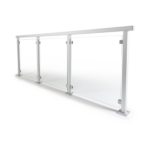
The easiest way to clean a glass balustrade is with lukewarm water, a mild cleaning product and a soft microfibre cloth or window squeegee. Avoid harsh or abrasive cleaners that may damage the glass surface or fittings. Cleaning frequency depends on the location: balustrades near the sea, roads or areas with high pollen levels may need more frequent cleaning.
A suitable water-repellent glass treatment can help reduce the build-up of dirt and limescale, but it does not replace cleaning. Wipe down glass clamps and stainless steel fittings with water and a mild detergent, following the product’s maintenance guidance.
Glass panels for balustrades have ground and polished edges to provide an even, smooth finish after cutting. This is especially important when the edges remain visible, such as with glass clamps or frameless glass balustrades. Edge finishing contributes to both appearance and quality.
Grinding removes uneven areas and minor edge defects left by cutting, while polishing produces a smooth, refined finish. Glass edges are more vulnerable to damage than flat surfaces, so careful edge finishing helps during transport, handling and installation. With exposed glass edges, such as panels held in clamps, the finish is also part of the design.
You choose the right glass balustrade based on location, view, desired look, and the requirements the railing needs to meet. Glass railings work both indoors and outdoors and can be built with posts, with glass clamps, or as post-free systems. frameless offers the best view, while posts can become a distinctive part of the design.
Clear glass preserves the view, while opal or tinted glass glass provides more privacy. Outdoors and along the coast, hardware, profiles, and metal components must be able to withstand the environment. Consider the glass, fixing, and load-bearing components as a complete system, especially where the railing provides fall protection.
Opal glass, also known as frosted glass, is usually a good choice when you want privacy without losing daylight. It allows light through while obscuring details on the other side, making it suitable for balconies, decking and closely spaced properties. Tinted glass reduces light and offers some privacy, but you can still see through it.
Clear glass offers the most light and an unobstructed view, but very little privacy. You can use opal glass facing neighbouring properties or the street and clear glass where the view matters most. Remember that tinted glass is not one-way privacy glazing: when it is brighter inside than outside, people may be able to see in more easily.
Yes, glass balustrades can be used as fall protection on balconies, terraces, and in public spaces, but it is the entire structure that determines safety. The glass, fixings, profiles, and substrate must be sized to accommodate the site’s intended use and load. When installed correctly, glass is a safe choice.
Laminated safety glass It stays intact if it breaks, and the glass lacks horizontal sections that could serve as footholds. A frameless glass balustrade is not automatically less safe than one with posts. The manufacturing process is certified according to EN 1090-1 and is continuously monitored by RISE. The requirements regarding height and openings depend on local building codes.
In some cases, you may be able to replace existing balcony balustrade glass with privacy glazing yourself, particularly where the balustrade already has posts and glass clamps. The replacement glass must be suitable for the existing system and must not compromise its safety. Depending on the installation, replacing the glass panels may be sufficient.
Check that the replacement glass dimensions suit the spacing between posts, that the clamps and rubber inserts are compatible with the glass thickness, and that the posts are secure. Opal glass offers privacy while admitting daylight. Larger panels should be handled by two people, ideally using suitable glass lifters. If you are changing more than the glass, check the structural fixings first.
In a glass balustrade, safety glass is used, which is tailored to the railing’s design, glass dimensions, fixing, and load. Common options include laminated ,safety glass, and toughened ,laminated glass, and the entire system determines which one is needed. The glass is selected based on the entire balustrade system.
Laminated glass consists of two glass panes bonded by an interlayer that helps hold the fragments together if the glass breaks. Toughened laminated glass is used where the system requires greater strength, such as for larger panels or exposed locations. If a pane cracks, it should be made safe and replaced because its properties have changed.
A pendulum impact test is a standardised test in accordance with EN 12600 that demonstrates how safety glass withstands a strong impact and how it behaves if it breaks. The glass is struck by a pendulum-mounted impact body dropped from specified heights, and the results show both the load level and the fracture pattern.
For glass balustrades, impact testing matters because people or objects may strike the glass. Safety glass should be strong and break in a controlled way. The test helps distinguish laminated from toughened glass. It assesses the glass, not the whole balustrade – fixings, posts and other components must also be correctly specified.
A glass balustrade provides a modern, open feel whether installed on a deck, balcony, indoor staircase or around a pool. It preserves the view and natural light while helping to reduce wind exposure. We manufacture every glass balustrade to your measurements at our factory in Ängelholm, so it fits your installation area.
On a deck, glass preserves views of the garden, lake or sea. On balconies, glass balustrades combine fall protection with wind shelter and, with the right glazing, can provide privacy. Indoors, they allow light to pass between floors, while full glass panels avoid gaps between infill bars. For doors opening without a balcony platform, explore our Juliet balconies. We also supply glass balustrades for pools and commercial spaces such as hotels and restaurants.
Clear glass offers the least obstructed view. Grey-tinted glass reduces light transmission slightly and can complement darker façades. Frosted opal glass lets daylight through while obscuring the view, making it an option for privacy screening.
Depending on the product, we use laminated safety glass made from two panes bonded together with a PVB interlayer that helps retain fragments if the glass breaks. Glass thickness is selected according to the loads involved: 8.76 mm laminated glass is used for many decks and patios, while we recommend 12.76 mm toughened and laminated glass for pool areas, exposed locations and Juliet balconies.
The manufacturing process is certified to EN 1090-1. Production is regularly monitored by RISE, with a focus on traceability, quality and the manufacturing process.
The price depends on the glass type, system and overall length. Our 8.76 mm laminated glass option is generally more economical than 12.76 mm toughened laminated glass. Frameless Vista is a premium option, while post-supported systems such as Arcus generally cost less. Fewer corners and longer straight runs can lower the price per metre. See your price directly in our 3D configurator.
Your glass balustrade is supplied as a complete kit with made-to-measure glass panels, posts, fixings and installation instructions. Fixings must always be suitable for the supporting substrate and load-bearing structure.
Your basket will be emptied if you change country.