

The cost of a railing isn’t determined by its length alone. To calculate the cost accurately, you need to base your calculation on the railing’s actual layout and take into account factors such as corners, stairs, changes in level, fixing, infill, and other choices that affect the design.
Two railings with the same total length may therefore have different prices. A long, straight section along a deck may be easier to install than several short sections around a loft or an upper floor, and a staircase balustrade must also be adapted to the staircase’s slope and connections.
A general price per metre therefore provides only a limited picture of the cost. To get a more accurate price, you first need to measure the actual length of the railing and then factor in the material, mounting, and design choices specific to your project.
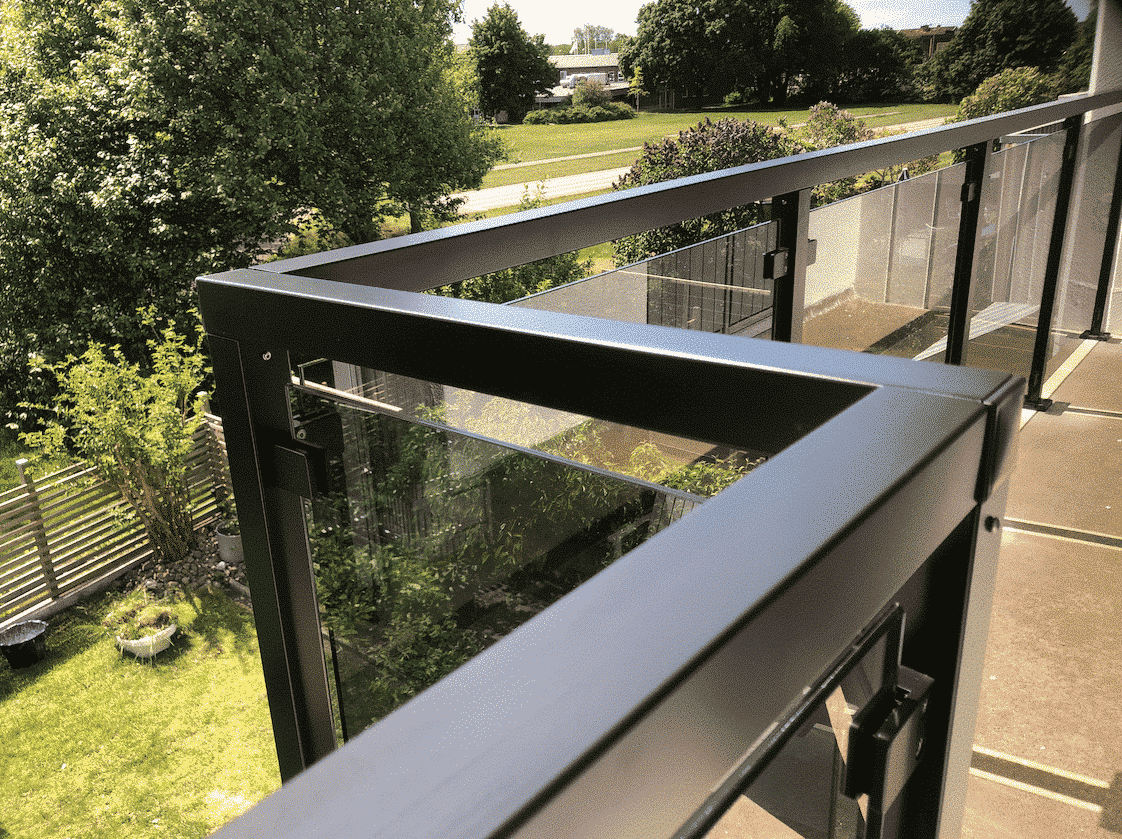
What has the greatest impact on the cost of a balustrade?
The shape and design of a railing often affect the price more than its total length. Two 12-metre railings can therefore cost different amounts if one is straight and the other includes several corners, stairs, changes in level, or other custom features.
12 metres along a straight edge
Fewer breaks and joints make it easier to divide the railing into sections and adapt it to the space.
12 metres with corners, stairs, and angles
The length may be the same, but more breaks and connections mean that the railing needs to be divided and adjusted in more places.
That is why a price per metre is rarely sufficient for comparing different railing systems. Once the basic design has been determined, the following factors, in particular, influence the final cost.
| Factors that influence | Why it affects the price |
|---|---|
| Number of corners | Each corner breaks the straight line and affects how sections and connections need to be designed. |
| Stair sections | A staircase balustrade must be adapted to the slope of the staircase and to how the sloped section connects to the rest of the railing. |
| Changes in level | When the height changes, the railing often needs to be divided into sections, and each section must be measured according to its own level. |
| Fixing | The substrate and the method used to install the railing determine which posts, brackets, and structural solutions are required. |
| Infill | Glass, slats and other types of infill use different materials and construction methods, which can lead to different prices. |
| Top rail | The choice of top rail affects which components are included in the railing and may therefore affect the total cost. |
| Colour | Standard colours and custom paint finishes may vary in price depending on the finish selected. |
Start with the railing's actual shape and length. Once that's correct, you can compare fixing, the filling, colour, and other options without the number of metres being misleading.
What is a standard balustrade?
By “standard railing,” we mean a railing with a relatively simple design and few customisations. This is not a fixed product definition, but rather a way to describe a project that is close to a simpler, basic design.
A straight run, a simple fixing, a standard colour, and an uncomplicated infill typically make the railing easier to divide and customize. Corners, stairs, changes in level, and other special solutions, on the other hand, make the project more specific and can affect the price.
Four choices that usually make the balustrade simpler
The more of these conditions that apply, the easier it usually is to measure, divide, and adapt the railing to the space.
Straight run
The railing follows a straight line without any corners, stairs, or changes in level that interrupt its continuity.
Simple fixing
The balustrade is installed on a suitable supporting structure without the fixings needing special adaptation for, for example, a staircase or a complex edge.
Standard Colour
The railing is selected in one of the colours from the standard lineup instead of opting for a more project-specific colour scheme.
Simple infill
Slats are one example of an infill that can provide a simpler basic solution than more project-specific alternatives.
What factors affect the price of balustrades for indoor use, in lofts, and on stairs?
For indoor installations, the price is often influenced by the number of short sides, corners, end caps, and connections the railing requires. A loft or upper floor may therefore be more project-specific per metre than a long, straight section of outdoor railing.
For a stair balustrade, there are also sloped sections and transitions to horizontal sections. The supporting structure at the fixing points and any unusual angles also affect how the solution needs to be constructed.
This makes the solution more project-specific
- Several short sides
- A loft or an opening can consist of several separate sections. This results in more ends and connections than a single long, straight side.
- The staircase connects to the railing
- The transition between sloped and horizontal balustrade sections must be adapted to the angle of the staircase and how the various sections meet.
- Edge of the floor structure
- The fixing must be planned based on the load-bearing structure. The composition of the substrate therefore affects which installation solution can be used.
- Young children using the space
- In areas where young children may be present, the openings and design of the railing must be evaluated as part of the overall safety measures. This may affect which railing solution is appropriate.
- Skewed or uneven angles
- In older houses, for example, the railing may need to be adjusted based on measured angles rather than assuming perfectly right angles.
Does a handrail cost less than a staircase balustrade?
A " handrail " is often less expensive because it typically consists of fewer parts than a complete " staircase balustrade." However, " handrail " and staircase balustrade serve different purposes, so they cannot always be compared as two equivalent alternatives.
The price of a handrail is primarily determined by its length, material, number of brackets, and the surface to which it will be attached. A staircase balustrade must also be customized to fit the staircase’s slope, open side, fixing, and connections.
Handrails and railings meet different needs
If the staircase has a wall on one side and an open side on the other, a handrail can provide support along the wall while the balustrade protects the open side. Therefore, it is not always possible to choose one over the other based solely on price.
Is an aluminium balustrade cheaper than a timber balustrade over time?
Not necessarily at the time of purchase. A simpler wooden railing may have a lower purchase price, while aluminium often requires less ongoing maintenance. To compare the cost over several years, you therefore need to take into account the purchase price, upkeep, and future maintenance.
| Materials | When making a purchase | Over time |
|---|---|---|
| Timber railing | A simpler timber railing may have a lower purchase price, depending on its dimensions, design, and the amount of work done on site. | Outdoor wood requires maintenance and periodic surface treatment. This entails both material costs and time over the railing's lifespan. |
| Aluminium railing | The purchase price may be higher than that of a simpler wooden railing and, just like with other railings, is influenced by its shape, fixing, and design. | Aluminium generally does not need to be painted or treated in the same way as wood. Routine maintenance consists mainly of cleaning and inspection as needed. |
A lower purchase price does not automatically mean a lower cost over time. Therefore, compare both the initial cost of the railing and the maintenance the solution will require over the years you plan to keep it.
How do you compare the prices of two balustrade solutions?
Change one thing at a time. Start with the railing in the shape you want, and then create a simpler version where only the curvature is different. If the height, fixing, infill, and colour are the same, the price difference will more clearly show how much the corners and angles cost.
Keep all other selections unchanged
-
Start by setting up the railing the way you want it
Enter the planned layout, including all corners, angles, and elevation changes. This will serve as the starting point for the comparison.
-
Just simplify the layout
For example, remove a corner or straighten out a section of the railing. Keep the height, fixing, infill, and colour unchanged so that only the shape distinguishes the versions from one another.
-
Compare the price difference
When all other factors remain the same, it becomes easier to see how much the more complex layout affects the cost and whether that difference is reasonable for the project.
If you change several things at once, it's impossible to tell what's causing the price difference. Therefore, compare the shape first, and then the material or design options separately.
How do you get an exact price for a balustrade?
The fastest way is to enter the railing's actual dimensions and shape into the 3D configurator. The price is updated when you change the span, fixing, and other selections that affect the design.
Start with the design, and then add the options specific to the project. That way, the price is based on the railing that will actually be ordered, rather than on a general price per metre.
Calculate based on the railing that will actually be built
The dimensions and layout determine the basic shape. Once they're right, you can change the design and appearance and see how each choice affects the price.
Form first. Details second.
Three items to add
Dimensions and corners
Enter each section of railing and mark all corners, stairs, and changes in level so that the price is based on the project's actual layout.
Height and fixings
Specify balustrade height and how the railing is to be installed. The substrate and fixing method determine which components need to be included in the solution.
Filling and Colour
Once the basic design is complete, you can compare, for example, glass and slats or different colours, and see how each choice affects the price.
Complex projects may need to be viewed as a whole
If the railing has multiple levels, unusual angles, or fixings you are unsure about, the dimensions and site conditions may need to be reviewed before the final solution and cost can be assessed.
What do you need to check to get the right price for a balustrade?
Accurate pricing starts with the right measurements and a clear picture of how the railing will be installed. Check these five points before calculating the final cost.
Make sure you have this figured out from the start
-
Have you measured the entire length of the railing?
Measure each side where the railing will be installed and mark all the corners. For lofts and other openings, each side must be measured separately—not just as a total number of metres.
-
Are there any stairs or changes in elevation?
Mark them separately. A staircase or change in level divides the run and may require different angles, sections, and connections than a horizontal railing.
-
Do you know what kind of substrate the railing should be fixed to?
Check the surface and how the railing is to be installed. Outdoors, for example, the supporting structure might be timber decking or concrete, while an indoor railing may need to be anchored to a floor joist or another suitable load-bearing element.
-
Have you decided what type of infill the balustrade should have?
Glass, slats and other infills require different materials and construction methods. Decide on the infill before comparing the final price.
-
Have you decided on the colour?
The standard colour and other colour options may affect the price. If you're comparing several railing solutions, the colour should be the same so that you're comparing them on an equal basis.
Dimensions, corners, stairs, level differences, and fixing determine how the railing needs to be built. Once those elements are correct, you can compare panel options, colours, and other choices without changing the basic requirements.
How do you choose the right balustrade for your project and budget?
Once you have the measurements, length, and fixing, it will be easier to compare different railings and see which materials and styles suit both the location and your budget.
Frequently asked questions about the cost of a railing
Here are brief answers to frequently asked questions about pricing at aluminium balustrade, staircase balustrade, loft railings, handrail, and various material options.
How much does an aluminium balustrade cost?
It depends on more than just the length of the railing. The shape, number of corners, stair sections, differences in level, fixing, the filling material, and the colour all combine to determine the cost of the finished aluminium balustrade.
Why isn't there a fixed price list per metre?
Two railings with the same total length may have different prices if one is a straight run and the other includes several corners, stairs, or changes in level. Therefore, a general price per metre does not provide the full picture of the cost.
How much does a staircase balustrade cost?
The price depends, among other things, on the staircase’s length and slope, the number of sections, fixing, and how staircase balustrade connects to the horizontal handrail sections. Therefore, a staircase balustrade typically needs to be calculated based on the specific staircase in question.
How much does a loft balustrade cost?
For a loft railing, the number of sides, corners, ends, and joints affects the cost. Therefore, several short sections of railing may result in a different price than a single long section with the same total length.
What factors affect the price of a handrail?
The price of a handrail is primarily influenced by its length, the material, the number of brackets, and the substrate to which it will be attached. A longer handrail or an installation that requires more mounting points may therefore result in a higher cost.
Does choosing glass or slats affect the price of an aluminium balustrade?
Ja. Glas och spjälor innebär olika materialåtgång och konstruktion. Även utförandet och hur fyllningen ska monteras påverkar därför det slutliga priset.
Can a custom powder-coated finish affect the price of the balustrade?
Yes. Standard colours and custom finishes may vary in price depending on the finish you choose. Therefore, the colour should be the same when you compare the prices of different railing solutions.
Can regulations and safety requirements affect the price of the balustrade?
Yes, indirectly. The height and design of the railing need to be adapted to the site’s conditions and intended use. If safety requirements influence the choice of railing solution, they can therefore also affect the final price.

