

With the right windbreak for your deck or balcony, you can create shelter where you actually spend time and make your outdoor space more usable for a larger part of the year. By shielding the side where the wind comes in, you can reduce drafts without having to enclose the entire outdoor space.
Which solution works best depends on the location. On an open deck, wind direction and exposed corners can be decisive factors, while a balcony also places demands on how windbreak is positioned and secured to the existing structure.
In this guide, we’ll go over materials, placement, and different types of windbreak for patios and balconies, as well as what you need to check regarding fixing, regulations, and any permit requirements before choosing a solution.
Which windbreak is best suited for decks and balconies?
On a patio, it’s often enough to shield the side or corner where the wind hits the seating area, while a more exposed balcony needs to be assessed based on wind direction, the existing railing, and possible fixing. If you also want to reduce visibility from the outside, that will also affect which material and design are best suited.
| Location | Common problem | A solution that often works |
|---|---|---|
| Ground-level deck | Draughts around the seating area | Protection on the windward side or around the corner where the wind most often enters. |
| Deck with an open view | Wind from multiple directions | Windbreaks on two sides, or an angled arrangement, can provide better shelter than a single straight screen. |
| Balcony on an upper floor | Strong winds and an exposed location | A permanent solution designed to fit the railing, fixing, and wind conditions at the site. |
| Balcony where you do not control the building façade | Permanent installation may affect the façade or railing | Check the requirements that apply to the building before the design and fixings are determined. |
| Seating or dining area | Wind makes the seating area uncomfortable | Protect the side where the prevailing wind hits the area where you are actually sitting. |
| Facing the street or a neighbour | Both wind and overlooking | Frosted glass or another more opaque screen can provide shelter from the wind while reducing overlooking. |
Once you know where the wind is coming from, it becomes easier to determine which windbreak for a deck or balcony is right for the space and how much of the outdoor area actually needs to be protected.
Why does a windbreak make such a big difference on a deck or balcony?
A windbreak makes a difference primarily by reducing air movement around where you're sitting. This makes the patio feel less drafty, and your body doesn't cool down as quickly, even if the outdoor temperature is the same.
Fewer draughts around the seating area
When the prevailing wind is reduced where you're actually sitting, the outdoor space becomes more comfortable without having to enclose the entire patio or balcony.
A more relaxed atmosphere around the table and in the seating area
Less wind means that candles, table settings, and other light objects are less affected by gusts. This can make the dining area or seating area calmer and more pleasant to use.
More days when you can enjoy the outdoor space
When the wind isn't as chilly, the same outdoor temperature can feel more comfortable, especially in the spring, autumn, and on windy summer evenings.
Should you choose a glass or wood windbreak?
Choose glass when you want a solid windbreak that still lets in light. Clear glass is suitable when the view matters, while frosted glass provides more privacy. Timber and slats create a more prominent material finish, but the gaps allow some air to pass through the screen.
| Property | Clear glass | Frosted glass | Wood and slats |
|---|---|---|---|
| View | Maintains a view of the garden, the water, or the surrounding area. | It limits visibility through the glass but still lets light through. | How much you can see through the screen depends on the width, orientation, and spacing of the slats. |
| Overlooking | Provides shelter from the wind but very little privacy. | Provides both shelter and greater privacy than clear glass. | May reduce overlooking, but the effect depends on how closely together the slats are placed. |
| Wind | The continuous glass surface does not allow air to pass through the surface itself. | It has the same dense basic structure as clear glass. | Reduces wind but allows air to pass through the openings between slats. |
| Maintenance | Clean the glass surface as needed to maintain its clarity. | Clean in the same way, following the care instructions for the glass and the system. | Maintenance requirements vary depending on the type of wood, surface treatment, and exposure. |
| Appearance | Creates an open and visually light look. | It feels more secluded but still lets in plenty of light. | Creates a more distinct timber or slatted appearance and can feel more inviting. |
| Best for | When the view is an important part of the outdoor space. | When you want shelter from the wind and greater privacy. | When you want to slow down the wind but do not need a completely solid screen. |
If your main goal is to reduce visibility, it may be worth comparing windbreak with a more specialised privacy screen for a patio or balcony, since the need for privacy can affect both the materials and how dense the structure needs to be.
Where should the windbreak be placed for best results?
Place the windbreak where the prevailing wind hits the seating area, the dining area, or the part of the patio that is used the most. The goal is to create shelter where people spend time, not to shield as large an area as possible.
- Find the wind direction
- Start by determining where the wind usually comes from. In many outdoor spaces, there is one side or corner that accounts for most of the draught, which means you don't need to shield the entire edge.
- Start with the area where you spend time
- Prioritise the seating area or dining area. A shorter windbreak in the right spot can be more effective than a longer one that doesn't block the wind where you're actually sitting.
- Take the corners into account
- Wind can flow around the end of a straight screen. In an exposed location, a screen around a corner or in an L-shape can therefore provide better shelter than a single straight section.
Where can the windbreak be placed on a balcony?
Common locations include above the balcony balustrade, on the short side, or on two sides at the same time. The best solution depends on where the wind enters, where you spend your time, and whether the existing structure is suitable for the intended fixing.
Above the railing
This might be a good option when the wind is blowing mainly across the front of the balcony and you want to retain daylight and the view at the same time.
On the short side
This can be useful when crosswinds are a problem, for example, when the wind blows around a corner of the building and hits the seating area from the side.
On two sides
This may be relevant on a more exposed balcony where the wind blows both over the front and from the side.
When is a retractable windbreak a good choice?
A retractable windbreak is ideal when the wind is only a problem occasionally and you want to be able to open up the patio again when it’s calm. It offers greater flexibility than a fixed screen, but works differently when the wind gets stronger.
Retractable solutions are available in a variety of fabric materials and can be practical on smaller decks and balconies where you want to be able to switch between a sheltered area and a completely open space.
You want to be able to adjust your protection based on the weather
A retractable windbreak is especially useful when the wind is a nuisance only on certain days or at certain times, and you want to be able to retract the windbreak when the weather is calm.
It can also be a good option for a smaller patio where a permanent windbreak would feel too overpowering when it isn't needed.
A fabric screen behaves differently from a fixed screen
A retractable fabric screen can move when the wind picks up and does not provide the same type of tight, stable barrier as a fixed glass surface.
Infästning, tillåten användning och hur mycket vind lösningen klarar behöver därför bedömas utifrån den aktuella produkten och hur utsatt platsen är.
If you are not responsible for the building or the balcony, you should check what requirements apply before installation, even if the windbreak can be retracted or folded away.
Which windbreak solution is best for the deck?
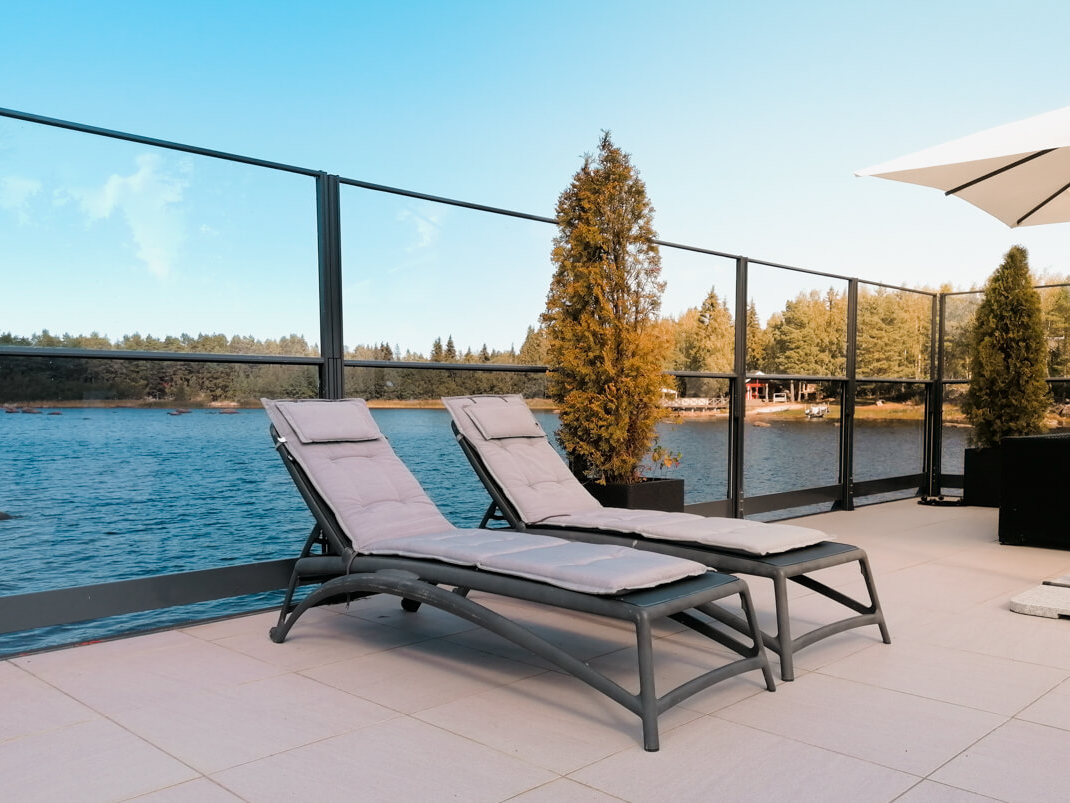
Start with the need that’s most important for your specific deck. Clear glass is a good choice when you want to preserve the view; a more privacy-oriented solution when the view into your space is a concern; an angled screen when the wind comes from multiple directions; and an adjustable solution when your need for shelter varies with the weather.
Clear glass
Choose an uninterrupted clear glass panel when you want shelter around the seating area without obstructing views of the garden, water or surrounding landscape.
More shielding surface area
Frosted glass or a more opaque screen is a good choice when you want shelter from the wind as well as greater privacy. How much overlooking you need to prevent will determine how opaque the screen should be.
Angled solution
If the wind often blows around the end of a straight screen, a second angled section can create better shelter around the part of the deck where you spend the most time.
Adjustable windbreak
An adjustable solution is suitable when you want more shelter on windy days and a more open patio when the weather is calmer.
Should you build a windbreak yourself or choose a ready-made system?
A custom-built windbreak may be suitable for simpler solutions in wood and slats, where you want to control the dimensions and design yourself. For glass and more exposed locations, the interplay between dimensions, fixing, and the load-bearing structure becomes more important, which may make a ready-made system more relevant.
Is bamboo a good material for a windbreak?
Bamboo can serve as a simple screen when your main goal is to create a softer, cosier atmosphere. However, as a permanent windbreak in an exposed location, the material is more susceptible to weathering than, for example, glass, and requires more maintenance over time.
Outdoors, bamboo is affected by moisture, sunlight, and temperature fluctuations. The material may turn grey, crack, and change over time, and since a bamboo screen is not completely impermeable, it dampens the wind rather than blocking it.
Bamboo is therefore best suited when you view it as a decorative or simple screen. If the main goal is to create a stable shelter on a wind-exposed deck or balcony, a permanent solution designed for windbreak is a more appropriate choice.
What rules might apply to a windbreak?
Regulations and any permitting requirements may depend on the windbreak’s height, density, location, fixing, and whether it is installed on or near a building. The requirements may also differ between a freestanding windbreak and a solution that affects an existing railing or facade.
Evaluate the entire structure – not just the height
There is no single dimensional limit that can be applied to all windbreak. The applicable requirements may depend on factors such as the structure’s height, density, function, location, and fixing, as well as how it affects the surrounding environment.
Therefore, check the current requirements before ordering or installing, especially if the windbreak is tall or dense, located near a property line, permanently mounted on a building, or intended to serve as a barrier in the event of a difference in elevation.
Height and solidity can affect which requirements apply
A low, open windbreak may be assessed differently than a tall and dense structure. The function of the windbreak and how permanent the solution is can also affect which regulations or permitting requirements need to be checked.
Location and fixing method may result in different requirements
Placing the unit near a boundary, on a balcony, or against a building may involve different conditions than installing a freestanding windbreak on an open patio. Therefore, check both the location and how the unit will be mounted before deciding on the final solution.
Rules and guidelines are subject to change. Therefore, always check the most up-to-date information with your municipality or the relevant authority for the location where the windbreak is to be built or installed.
How do you choose the right windbreak for your deck or balcony?
Start by considering the wind direction and the part of the patio that actually needs shelter. Once the location, materials, privacy, and regulations are clear, it becomes easier to choose a windbreak that works without enclosing more space than necessary.
Six things to consider before choosing a windbreak
-
Where does the wind come from?
Identify the prevailing wind direction over the course of a few windy days. This will show you which side or corner is actually causing the draft.
-
Where do you need to create shelter?
Start with the seating area, dining area, or the part of the outdoor space that’s used the most. You don’t necessarily have to enclose the entire deck or balcony.
-
How much of the view do you want to retain, and how much overlooking do you want to prevent?
Clear glass preserves the view, frosted glass provides more privacy, and slats create a more open form of protection that still allows some air to pass through.
-
What material is best suited for this location?
Choose a material based on how much wind protection you need, how important the view is and how much ongoing maintenance you are prepared for.
-
Do regulations and any permit requirements need to be reviewed?
Check the relevant requirements if the windbreak is tall or solid, is fitted to a balcony or existing balustrade, or is positioned at a boundary.
-
Have you carefully measured the whole space?
Check the lengths, corners, level differences, existing posts, and possible mounting points before deciding on the final solution.
Are you looking for the right windbreak for your patio?
Explore our windbreaks once you know where the wind is coming from and which part of your patio needs shelter. If you need help with measurements, materials, or choosing a solution, please contact customer service.
What should you know before choosing windbreak for your deck or balcony?
In addition to materials and placement, it’s a good idea to consider what function the windbreak should serve, how it interacts with existing railing systems, and whether the solution needs to function the same way throughout the year.
What is the difference between a windbreak and a privacy screen?
The primary purpose of a windbreak is to reduce the wind where you are, while a privacy screen primarily limits the view into the patio area. The same design can serve both functions, but the materials and density must then be chosen based on which need is most important.
Can a windbreak be fitted to an existing balustrade?
That may be possible, but an existing railing is not automatically designed to accommodate the additional wind surface area created by a windbreak. The railing, fixing, and the supporting structure must therefore be suitable for the intended solution.
Does the entire deck need to be enclosed to create shelter?
No. Often, it’s enough to shield the side or corner where the dominant wind hits the seating area or dining area. A smaller windbreak in the right spot can therefore provide better shelter than a larger screen that doesn’t block the wind where you’re actually sitting.
Can a windbreak be useful year-round?
Yes, a windbreak can reduce drafts even during the colder times of the year, but it does not raise the outdoor temperature. How an adjustable or retractable solution should be used in different weather conditions depends on the system you choose and its instructions.
What do you need to check before installing a windbreak on a balcony?
Verify that the railing, fixing, and load-bearing structure are suitable for the solution and comply with the requirements for the building. If you are not responsible for the building or the balcony, you must also verify what is permitted before attaching windbreak to the railing or facade.

