

For a patio awning that is used frequently or is wide, a motor is usually the most convenient choice, while crank handle is a good option when you want a simpler, non-electric solution at a lower price.
Which operating system is best suited for different patio awnings depends primarily on the size of the awning, how often it will be used, and whether there is electricity at the installation site. With a motor, awning can be controlled using, for example, a remote control and supplemented with automatic control, while a manual crank handle operates entirely without electricity.
Here, we compare motorised and crank handle options based on comfort, installation, price, and usability, so you can more easily decide which solution is right for your patio or balcony.
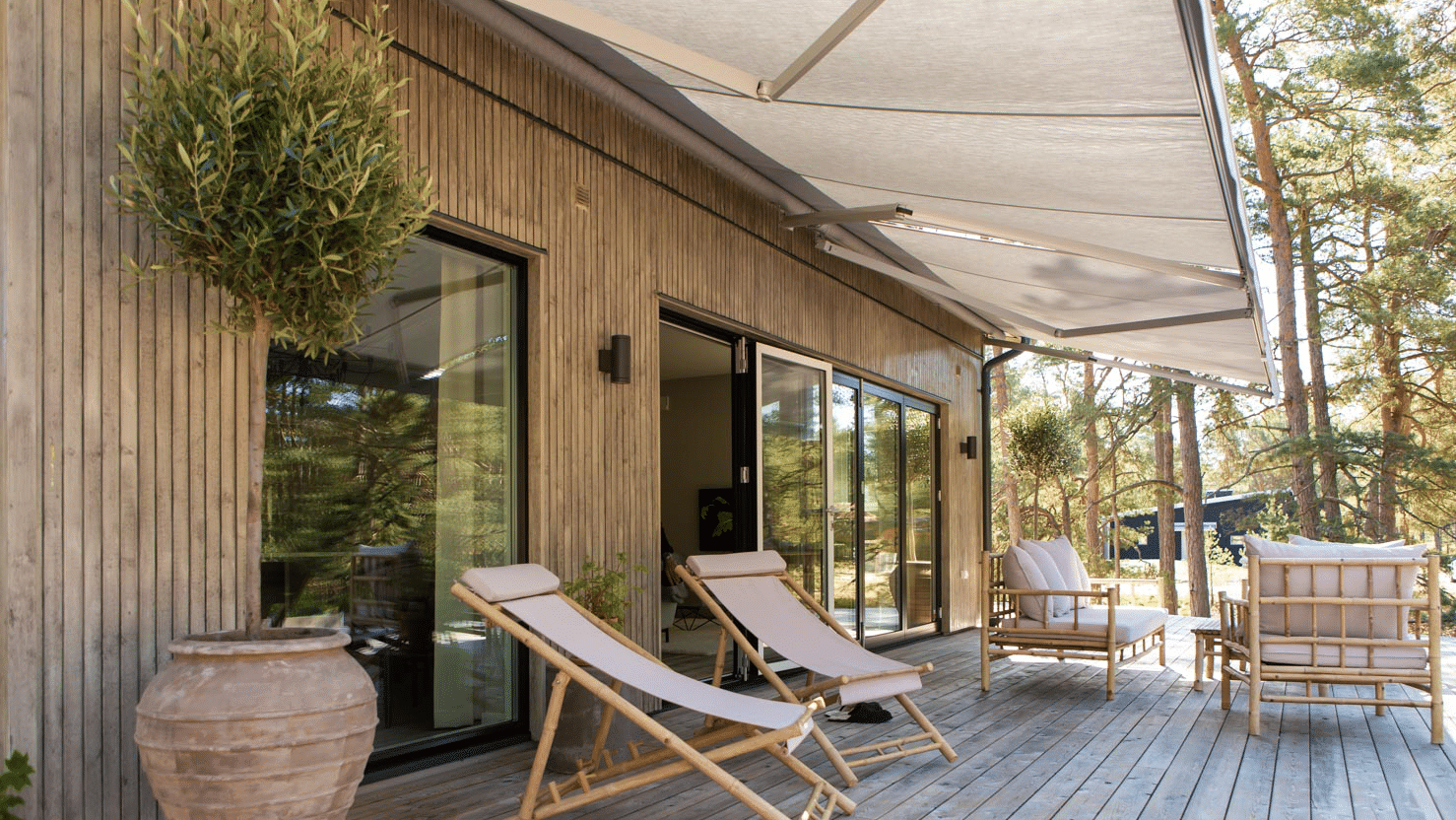
When is a motorised patio awning the best choice?
A motorised patio awning is particularly well-suited when awning is used frequently, is wide, or when you want to be able to open and close it without physical effort. The motor is concealed inside the awning’s tube, and it is typically controlled via a remote control, wall switch, or a compatible control system.
For a larger patio awning, the difference is evident in everyday use: instead of cranking it all the way out or in, the motor does the work for you. Depending on the model and optional features, the control system can also be supplemented with, for example, a timer or a sun and wind sensor.
When is a patio awning with crank handle a better choice?
A patio awning with crank handle is a good choice when you want a simple solution without electricity, use awning more sporadically, or want to keep costs down. Awning is opened and closed manually using a crank handle that operates the mechanical gear.
Since it doesn't require electricity to operate, the crank handle is particularly well-suited for locations without a suitable power connection. However, you'll need to handle all operation yourself and remember to retract the awning when weather conditions require it.
- No electricity is needed
- The crank drive operates entirely mechanically and therefore requires no motor connection at the installation site.
- Lower purchase cost
- A manual awning is usually less expensive than the equivalent solution with a motor and electronic control system.
- You operate the awning using a crank handle
- The larger the awning, the more noticeable the manual operation becomes. It is therefore worth considering both the size of the awning and how often it will be used.
- No automatic control
- With the crank handle, you manually raise and lower the awning. If you want to use automatic sensor control, for example, you'll need to choose a compatible motorised solution instead.
A smaller or less frequently used awning where ease of operation and independence from electricity take precedence over automation and maximum convenience.
What is the difference between patio awning (with a motor) and crank handle?
The biggest difference is how awning is used in everyday life. The motor makes maneuvering easier and allows for automatic steering, while crank handle is a simpler solution that works without electricity and typically has a lower purchase price.
| Property | Motor | Winding handle |
|---|---|---|
| Operation | Controlled electrically using, for example, a remote control or a wall switch. | Opens and closes manually using crank handle. |
| Electrical connection | Yes, the motor needs power. | No, the operation is entirely mechanical. |
| Automatic control | Depending on the system, it can be supplemented with, for example, a solar or wind sensor. | No, you operate the awning yourself. |
| In the event of a power outage | The procedure depends on the motor solution and any backup control system that has been selected. | Not affected by power outages. |
| Price | The motor and any control system incur an additional charge. | Usually the less expensive operating option. |
| Often the best fit | For frequent use, larger awnings, or when comfort is a priority. | For more sporadic use, simpler needs, or in situations where there is no electricity. |
Should you choose a motor or a crank handle for your patio awning?
Choose the motor if awning will be used frequently, is larger, or if easy operation and automatic control are important to you. Choose crank handle if awning is used less frequently, if there is no electrical power at the installation site, or if you want to keep costs down.
On a awning for a deck that is opened and closed almost every day, the convenience of a motor is more noticeable than on a smaller awning that is used only occasionally.
Convenience and frequent use are the most important factors
- The awning is often used during the day or for much of the season.
- The awning is larger, and you want to avoid having to crank it by hand.
- You want remote control or compatible automatic control.
Simplicity and independence from electricity are the most important factors
- There is no suitable electrical connection at the installation site.
- You want to keep purchasing costs as low as possible.
- The awning is used more sporadically, for example at a holiday home or on a small patio.
The larger the awning and the more frequently it is used, the more you’ll typically benefit from a motor. For a smaller awning that’s used less often, crank handle may be perfectly sufficient.
Is it possible to retrofit an engine on a patio awning with crank handle?
Yes, at Velum-awnings, it may be possible to switch from crank handle to a motor retroactively without replacing the entire awning. This allows you to start with manual operation and upgrade later if your needs for simpler control change.
The motor kit consists of a tubular motor, a remote control, and a connection cable. Before upgrading, however, you need to verify that your awning model and size are compatible with the motor solution.
Which awnings models are available with an engine, or crank handle?
The " Velum" series offers both manual and motorised operation, but the standard configuration varies by model. This allows you to balance the awning's design with the level of comfort and control you desire.
Velum Lite
crank handle by default
The compact patio awning can be equipped with a motor if you want to combine a more compact design with electric operation.
Velum Plus
Engine or crank handle
The more robust patio awning can be selected with an operating method to suit your needs, with the option of compatible motor control and optional features depending on the configuration.
Velum Pro
Motor as standard
The full-cassette patio awning comes with a motor as standard, while a crank handle is available as an alternative if you prefer manual operation.
Available operating and control options may vary depending on the model, dimensions, and configuration. Therefore, always check which options are available for the awning you plan to order.
What factors affect the price of a patio awning with an engine or crank handle?
The price of a patio awning depends on more than just the choice between a motorised or crank handle model. Size, awning model, cassette, fabric, and any control system all combine to affect the final price. A motorised model typically costs more than a manually operated one, but the exact price difference depends on the awning you configure.
Width and projection
A larger awning requires more material and sturdier components. Therefore, both the width of the awning and how far it extends affect the price.
Engine or crank handle
crank handle is usually the simpler and more affordable operating option. The motor, remote control, and any automatic features are added depending on the model and configuration.
Awning model and cassette
Construction makes a significant difference. A more enclosed cassette protecting the fabric and mechanism will generally differ in price from a simpler open awning.
Fabric and finish
The choice of fabric, colour, and any available styles may affect the final price, depending on the options available for the specific model.
Controls and accessories
For example, remote control and compatible solar and wind sensors can affect the price when you choose a motorised solution.
Because patio awnings are made to measure, you should always base your calculation on the current price for the size, model, and options you actually choose.
Which patio awning is right for your outdoor space?
Compare models, dimensions, and operating options based on the size of the area you want to shade and how you plan to use the awning day to day.
What do you need to know about patio awning with a motor or crank handle?
Here are brief answers to common questions about operation, electricity, automation, and cost when choosing between a motor and a crank handle for a patio awning.
Which is better for a patio awning —a motor or a crank handle?
A motor is usually the best choice when awning is used frequently, is larger, or when easy maneuvering and automatic steering are important. crank handle is a good fit when you want a simpler solution without electricity, use awning less often, or want to keep costs down.
Does a motor-driven patio awning need electricity?
Yes. A motor-driven patio awning requires a power source at or near the installation site. How the connection is made depends on the specific motor solution and installation.
Is it possible to retrofit an engine on a patio awning with crank handle?
At Velum-awnings, it may be possible to retrofit a motor from crank handle without replacing the entire awning. However, the model and size must be compatible with the current motor solution.
Can a motorised patio awning be controlled by a sun or wind sensor?
Yes, depending on the motor and control system, a motorised patio awning can be equipped with, for example, a sun or wind sensor. The available features depend on the model and the selected configuration.
What happens to a motor-driven patio awning during a power outage?
It depends on the motor solution used. The availability of manual backup operation may vary between different systems, so check how the selected awning can be operated in the event of a power outage.
Is a patio awning with an engine more expensive than one with crank handle?
Yes, the motor and any electronic controls usually result in a price increase compared to crank handle. The size of the difference depends on the awning model, size, and the options you choose.

