

A railing for an outdoor staircase must be able to withstand weather and moisture, provide a secure grip when the stairs are wet, and be anchored to a load-bearing structure. The materials, fall protection, and mounting hardware must therefore be selected based on both the staircase’s location and how it is used.
Outdoors, factors such as rain, frost, sunlight, salt, and movement in the ground or structure come into play. These factors influence both the choice of suitable material and how the railing should be installed to ensure it remains functional over time.
Once safety, grip, and fixing have been addressed, the railing’s design can be customized to match the house and the entryway—from transparent glass and stainless steel to aluminium, slats, or wooden accents.
What is the difference between a railing for an outdoor staircase and an indoor staircase balustrade?
A railing for an outdoor staircase must be able to withstand moisture, frost, salt, reduced traction, and movement in the staircase frame. Therefore, the outdoor environment influences the choice of materials, the handrail design, and how the railing should be anchored.
For an outdoor staircase, you also need to take into account that the ground and the structure may change over time, while the balustrade must remain functional even when hands and surfaces are wet.
| Factor | Outdoors | Indoors |
|---|---|---|
| Slippery conditions | Rain, Frost, and ice | Basically never |
| Grip | Wet hands and gloves | Dry hands |
| Materials | Must be able to withstand frost, salt, and UV rays | Greater freedom in material selection |
| Fixing | Ground and structural movements | Generally stable ground |
| Slope | May become uneven due to settlement | Usually even |
The handrail must remain easy to use even when wet
A profile that feels good with dry hands may be harder to grip with wet hands or gloves. A shape that offers a good grip and is easy to wrap your hand around is therefore especially important when outdoors.
What regulations apply to balustrades and handrails on outdoor stairs?
For an outdoor staircase, the handrail must provide adequate protection against falls and handrail support when going up or down. The applicable requirements depend, among other things, on the staircase’s use, drop height and the risk of injury.
Therefore, there is no single dimension or design that fits all outdoor staircases. Height, openings, handrail, and fall protection must be assessed based on the specific staircase and the requirements applicable to its location.
Fall protection, handrails and child safety must be considered together
Fall protection must be tailored to the risk
The height, stability, and design of the railing must be adapted based on the height of fall, how the staircase is used, and the requirements that apply at the specific location.
The placement of the handrail needs to be determined based on the staircase
Requirements regarding the number, placement, height, and ease of gripping the handrails may vary depending on the staircase's design and use. Therefore, check the specific requirements for the staircase in question.
Younger children should not be able to fall through or get stuck
In areas where young children are present, openings and clearances must be designed to reduce the risk of falls, climbing, and getting pinched. Exact dimensions must be verified in accordance with current guidelines.
Always check the current requirements with your municipality or the relevant authority.
What material is best suited for the balustrade on an outdoor staircase?
Powder-coated Aluminium and stainless steel are durable options that require little maintenance, while glass and wood may be appropriate when visibility or a warmer aesthetic is more important. The staircase’s exposure to moisture, frost, sunlight, and salt should guide the choice of materials.
Near the coast and at entrances where road salt is used, the material must be able to withstand a more demanding environment. A stainless steel railing in “ acid-resistant ” quality may then be a suitable option.
- stainless steel
- Acid-resistant High-quality material with excellent resistance to salt and moisture. A suitable choice for coastal areas and at entrances where road salt may be spread during the winter.
- Powder-coated aluminium
- Aluminium does not rust, and the powder coating provides a durable finish that does not require repainting. It is a common choice for entrance steps and other exposed locations.
- Safety glass with posts
- Glass maintains visibility while also providing some protection from the wind. It requires regular cleaning but no oiling, painting, or other surface treatment.
- Timber
- Wood has a classic, softer look but needs to be oiled or painted regularly. The handrail finish wears fastest because hands, moisture, and sunlight affect the surface finish.
What happens to the balustrade if the outdoor staircase moves?
If the outdoor staircase settles or moves differently than the house, a railing that is rigidly anchored to both structures may be subjected to uneven stress. Over time, posts, fittings, and fixings may begin to tilt or become loose.
This is particularly relevant for freestanding stairs on pedestals, paving stones, or a gravel bed, where frost, thawing, and ground movement can cause the stairs to shift without the building’s foundation moving in the same way.
The stairs are settling
Frost, thawing, and ground movement can cause the staircase to shift over time.
The balustrade is secured between two frames
The staircase pulls the railing in one direction, while a fixed fixing in the house holds it in place.
The fixings are subjected to stress
Posts and fittings may begin to tilt, become loose, or be subjected to uneven stress.
Make sure the railing follows the staircase's design
-
Avoid rigidly fixing the balustrade to both structures
Normally, let the load-bearing fixing follow the staircase. On the side facing the house, the railing can end without being rigidly anchored to two structures that may move differently.
-
Measure the slope at several locations
Older staircases may have settled unevenly. Therefore, check the top, middle, and bottom sections before ordering the railing.
How do you choose the design of a balustrade for an outdoor staircase?
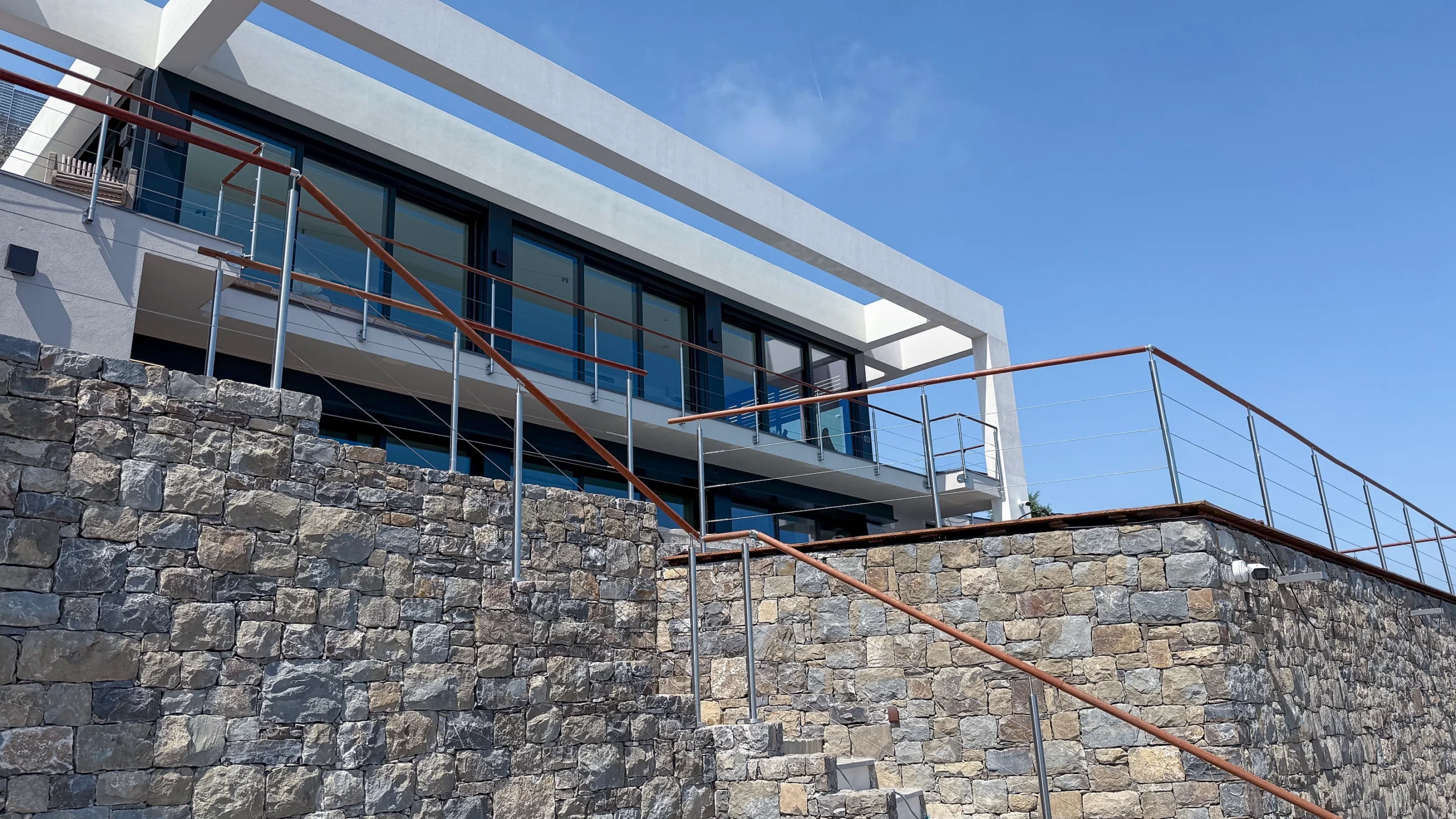
First, choose a railing that provides a secure grip and works well with the staircase’s design. Then, you can adapt the materials, lines, and details to the façade so that the railing either blends in or becomes a more prominent feature of the entrance.
If someone needs extra support, a continuous handrail for the stairs should be prioritized over decorative details. The hand should be able to follow it along the entire walking path without unnecessary interruptions.
What should you check before ordering a balustrade for an outdoor staircase?
Before ordering a railing, check the staircase’s slope, load-bearing structure, exposure, choice of materials, installation instructions, fixing, and slip hazard. This will make it easier to choose a solution that suits both the staircase and the outdoor environment.
Check the staircase before finalising the measurements and materials
-
Measure the slope at several locations
Check the top, middle, and bottom sections of the staircase. Older staircases may have settled unevenly and therefore need to be measured at more than one point.
-
Check the staircase frame
Find out whether the staircase is cast or made of wood. The fixing must be sized and positioned based on the load-bearing substrate.
-
Assess how exposed the location is
Check whether the staircase is located near the coast, is exposed to rain and frost, or is exposed to road salt during the winter.
-
Choose materials based on the climate
Base your decision on moisture, salt, and maintenance needs – not just on appearance. In harsh environments, you need materials that can withstand the stresses over time.
-
Choose a handrail that is comfortable to grip
The handrail should be easy to grip, even with wet hands or gloves. An oval shape often provides a firm and stable grip.
-
Plan fixing
Anchor the railing to the staircase's load-bearing structure, and avoid rigidly securing it to both the staircase and the house if the structures are capable of moving independently of one another.
-
Check the slip resistance at the same time
The balustrade provides support, but does not eliminate the risk of slipping. Therefore, check whether the steps also need anti-slip protection, better drainage, or a surface with a coarser texture.
In that case, the railing can be designed based on the correct conditions
Once you’ve reviewed the slope, frame, climate, handrail, and fixing, you’ll have a better basis for determining dimensions, materials, and handrail options.
Which balustrade is right for your outdoor staircase?
The right balustrade must suit the staircase’s slope, load-bearing structure and outdoor environment, while the handrail provides a secure grip. Once those factors have been checked, you can compare materials and styles or ask for help assessing the options.
What should you know about balustrades for outdoor stairs?
Here are brief answers to frequently asked questions about materials, fixing, settlement, measurement, and outdoor handrails.
What type of balustrade material is suitable for use near the coast or in areas treated with road salt?
stainless steel AISI 316 stainless steel is a suitable choice in environments exposed to salt, as this grade acid-resistant offers high resistance to moisture and salt. Lower-grade stainless grades are more prone to surface rust and discolouration.
Can an outdoor balustrade start to tilt when the stairs settle?
Yes. Frost, thawing, and ground movement can cause the staircase to shift. If the balustrade is firmly anchored to both the staircase and the house, the posts, fittings, and fixings may be subjected to uneven stress.
How should a balustrade be fixed to an outdoor timber staircase?
Fixing must reach the staircase's load-bearing members. Tread boards and other surface layers should not bear the load from the balustrade on their own.
What should I measure before ordering a balustrade for an outdoor staircase?
Measure the slope of the stairs at the top, middle, and bottom. Older stairs may have settled unevenly, so a single measurement may not accurately reflect the actual slope of the entire staircase.
Is an oval handrail a good choice for an outdoor staircase?
An oval handrail profile is often easy to grip and can provide a secure hold even with wet hands or gloves. The profile’s size, surface texture and position also affect ease of use.
Can I use wood as a handrail outdoors?
Yes. Wood has a warm look and often feels less cold to the touch than metal in the winter, but it needs to be oiled or painted regularly because moisture, sunlight, and human touch wear down the finish.

