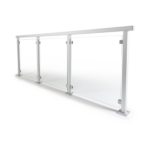
A railing for the porch needs to be suitable for both the daily use of the entryway and the overall look of the house. Therefore, choose the material and design based on how exposed the location is, how the railing will be used for support, and what style will complement the façade and entryway over time.
People often walk through the porch several times a day, year-round and in all kinds of weather. Shade, prolonged moisture, dirt, and sometimes road salt can therefore affect the material more than on a more open deck, while the railing is often used for support when going up and down the stairs.
A good choice, therefore, must balance maintenance, traction, fixing, and appearance. The material should be suitable for the specific location, while the colour and shape can complement the home’s architectural details to give the entrance a cohesive and timeless look.
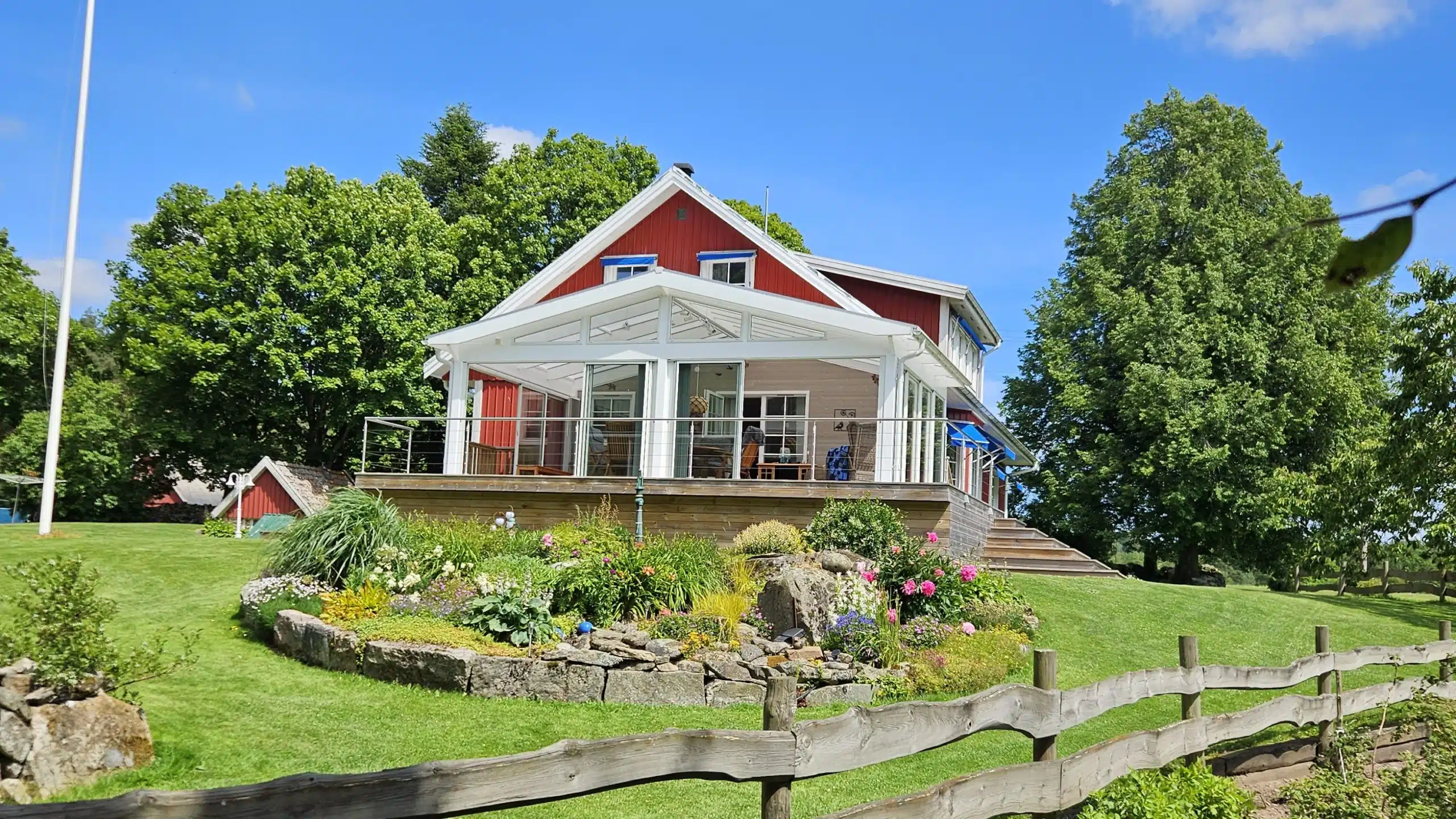
Why does a railing at the entrance wear out faster than a deck balustrade?
A railing at the entrance is used year-round and is often exposed to a combination of moisture, dirt, and slower drying conditions. Therefore, the materials and finish may face harsher conditions here than on a more open deck that is used primarily during the warmer months.
The entrance is used year-round
People walk along the railing and use it for support in rain, snow, slippery conditions, and dirt. This repeated use means that both the surface and the grip are exposed during more parts of the year.
Shade can slow down the drying process
An entrance that is shaded or sheltered from the sun can retain moisture longer after rain or snow. This gives the material less time to dry between changes in the weather.
The surface may require more regular maintenance
When moisture and dirt accumulate on the railing, the need for cleaning and maintenance increases. Wood is particularly dependent on the right surface treatment and regular inspection in a damp environment.
The material should therefore be chosen based on the entrance’s actual location and use – not just on how the railing looks when it’s new.
What material is best suited for balustrades on a porch and in an entryway?
Powder-coated Aluminium is a low-maintenance choice for many entryways, wh stainless steel e steel is suitable for environments that place higher demands on corrosion resistance. Wood can provide a more traditional look but requires more maintenance, especially in shady and damp locations.
When comparing railing options for your porch and entryway, it’s therefore wise to consider maintenance, weather exposure, the style of your home, and how much light and visibility you want to preserve.
| Materials | Best for | Things to Keep in Mind |
|---|---|---|
| Powder-coated aluminium | Many porches and entryways | Requires minimal ongoing maintenance and is available in several colours. |
| Acid-resistant stainless steel, 316L | Coastal and salt-exposed locations | Durable in salty environments, but the metal surface may feel cold to the touch in the winter. |
| Wood | Cottages, older houses, and traditional styles | Requires regular surface treatment and extra care in shady and damp locations. |
| Glass with a frame | Where light and an unobstructed view are important | It maintains the open feel around the entrance, but the glass surfaces need to be cleaned regularly. |
| Forged aluminium construction | Older façades and classic houses | It offers a more traditional look, while aluminium requires less maintenance than a comparable wooden railing. |
Aluminium and stainless steel are different materials with different properties. Therefore, when evaluating options, don’t just compare their appearance, but also their surface treatment, environmental impact, and the maintenance required by each solution.
Which profile is easiest to grip on an entrance balustrade?
For an entryway railing that is actually intended to be used for support, a round profile of about 42 mm is usually easier to grip with your hand than a wide, flat top rail. The difference is especially noticeable when it’s cold and you’re wearing winter gloves.
When designing a entrance steps, grip must therefore be taken into account as early as the railing selection stage. If top rail does not provide a good grip, a separate handrail may be worth planning in conjunction with the railing.
Easier to wrap your hand around
A rounded profile allows the hand to wrap around the top rail and is therefore ideal when the handrail needs to provide firm support. The shape is also easier to grip with gloves than a wide, flat surface.
Comfortable to rest your hand on, but harder to wrap your hand around
En bred, plan överliggare kan vara behaglig att lägga handen på eller luta sig mot, men handen kan inte omsluta profilen på samma sätt. Det kan göra den mindre funktionell när ett snabbt och stabilt grepp behövs.
Choose a grip shape based on the time of year when support is needed most. When selecting a entrance steps, performance in cold, slippery conditions, and while wearing gloves should be given greater weight than the overgrip’s appearance alone.
When is a balustrade required on a porch or at an entrance?
The requirements for fall protection depend on the site's design, the difference in elevation, its use, and the regulations that apply where the structure is located.
Height of fall, how the entrance is used and what is located on the surface below must therefore be taken into account. A small difference in level, for example, can pose a different risk if a fall occurs onto hard ground, steps, or a wall.
Three factors influence the risk of falling
How far can you fall?
Estimate the difference in level from the porch, the entrance, or the stairs to the surface below.
How is the entrance used?
Take into account how people move around the area and how often the porch, stairs, or ramp are used.
What can you fall against?
Hard surfaces, steps, walls, or other obstacles can make the consequences of a fall more serious.
The risk at the site determines
None of these factors alone determines the outcome. The height of fall, the intended use and the surface below must be evaluated together to determine whether a railing or other fall protection is needed.
What do you need to consider once the site has been assessed?
- If fall protection is needed
-
The height and design of the railing must be adapted to how the area is used, the level of fall risk, and the requirements that apply at the specific location.
- If the entrance has stairs or a ramp
-
If the entrance has stairs or a ramp, there may be specific requirements regarding the placement, number, and design of handrails. The handrail must also be easy to grip and work in conjunction with the railing. Check the current guidelines from your municipality or the relevant authority.
How do you attach a balustrade to a porch and entryway?
The railing must be anchored to a load-bearing part of the structure. How the fixings are arranged therefore depends on the substrate and on whether the post is mounted on top of the floor surface or on the side of the structure.
At an entrance, the same section of railing may abut, for example, decking, concrete, natural stone, or a masonry base. Therefore, check what is actually behind or beneath the surface layer before determining the placement and fixing.
The post stands on the floor
- Location
- The post base is mounted on top of the supporting surface and becomes a visible part of the floor surface.
- Suitable for
- This mounting method can be used on, for example, decking and concrete slabs when there is a suitable load-bearing substrate where the post is to be placed.
- To take into account
- The base of the post sits on the floor and must therefore be positioned so that it does not obstruct passage at the entrance or staircase.
The post is moved away from the floor
- Location
- The post is mounted on the side of the structure instead of on top of the floor or stair surface.
- Suitable for
- Side mounting can be useful when you want to free up more of the floor space or stair width for passage.
- To take into account
- The structure on the side must be accessible and have a load-bearing substrate to which fixing can be anchored.
The fixings must reach the load-bearing structure
The substrate determines which fixing can be used. In a timber structure, the railing must generally be anchored to a stud, stringer, or other load-bearing component—not just to a panel, deck board, or other surface layer.
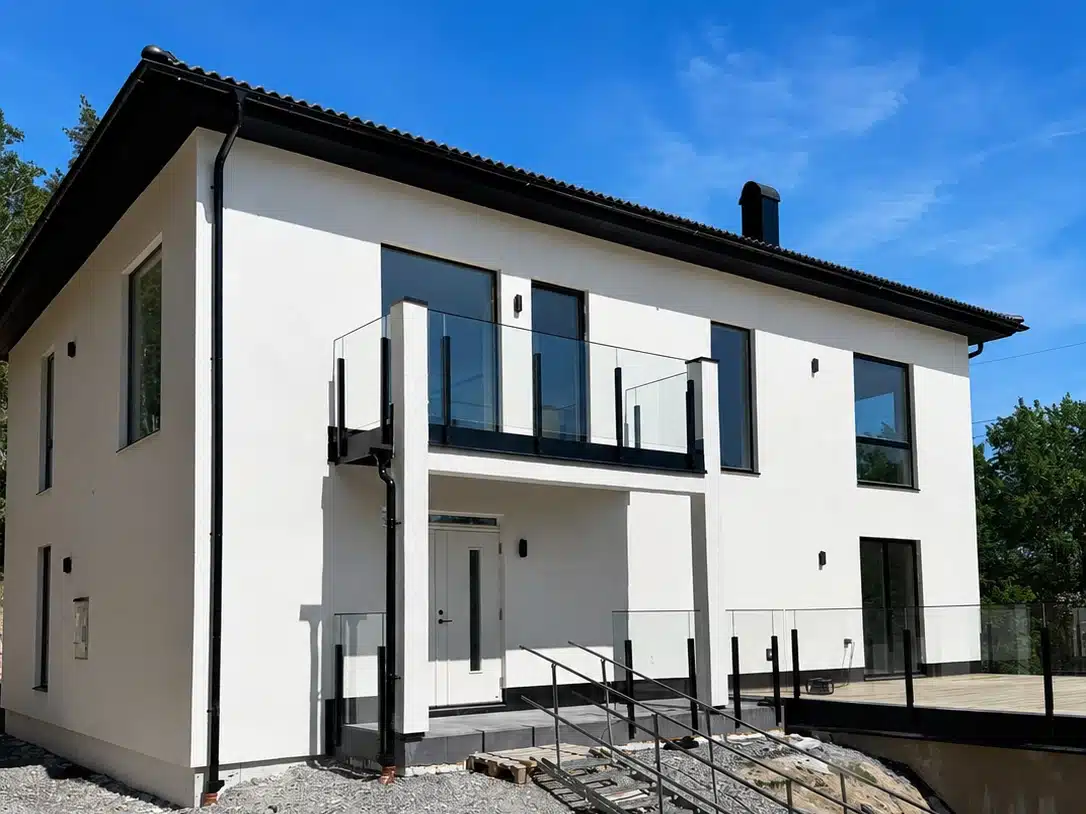
Should the front porch railing match the façade or the deck?
Start with the house itself. The entrance is part of the facade, and the railing often takes on a more cohesive look if its colour matches the window frames, front door, or hardware, for example, rather than the patio or other elements in the garden that are subject to change.
Let the railing become a graphic element
A black or dark railing against a light-coloured facade creates a distinct contrast. The railing then becomes a prominent feature of the entrance’s design and can tie in with, for example, dark windows, hardware, or doors.
Let the railing blend in with the overall design
A colour similar to that of the facade or the house’s other fixed elements makes the railing less visually prominent. This works well when you want the entrance to feel calm and cohesive rather than strikingly contrasting.
Both options can work. The important thing is that the choice is a conscious one and is based on the building’s permanent features, so that the railing still feels natural even when the furniture, plantings, and other elements around the entrance change.
What should you check before ordering a balustrade for your porch?
Consider how the entrance is used, the weather conditions the railing will be exposed to, what it will be attached to, and whether it also needs to serve as a support on a staircase. Then, the material, grip, placement, and fixings can be selected based on the actual conditions of the location.
Take a look at the porch and the entryway as a whole
Dimensions and appearance are only part of the decision. Also check the intended use, weather exposure, and the supporting structure before deciding on the railing design.
-
Assess how the entrance and staircase are used
Check how many steps there are and whether the handrail is primarily intended to serve as a fall protection, as a support when walking, or both.
-
Note the compass directions and how quickly the area dries
A shady and damp location places different demands on materials and maintenance than a sunnier and more sheltered porch.
-
Check all supports along the length of the railing
Note whether the railing meets decking, concrete, natural stone, a masonry base, or several different materials. The fixing must be adapted to the load-bearing structure of each section.
-
Choose a top rail based on how it should be held
If the railing is used as a support, the profile must be easy to grip even when wearing gloves and when the surface is cold or slippery.
-
Plan for any handrail along with the railing
For stairs or ramps, there may be specific requirements regarding the placement and design of the handrail. Therefore, check before placing your order to determine what requirements apply and how the handrail should work in conjunction with the railing.
-
Compare the colour with the building's architectural details
Feel free to start with the façade, window frames, front door, and hardware. This creates a more lasting visual connection than matching furniture or other elements that change easily.
-
Check the load-bearing capacity before drilling
Check what fixing is actually supposed to be anchored to before beginning installation. The forces exerted by the railing must be transferred to a load-bearing substrate—they must not remain confined to a weak surface layer.
This will give you a better basis for choosing a railing based on the location’s use, weather conditions, and design—while also allowing the material and colour to be tailored to the home’s style.
Which balustrade is right for your porch and entryway?
Compare our railings based on the dimensions, surface, and style of your entryway. If you need help determining which design is right for you, our customer service team can assist you further.
What are some common questions about balustrades for porches and entryways?
Here you'll find brief answers to some more specific questions about materials, handrail, fixing, and placement near the porch and entryway.
Can you have a glass balustrade on a porch?
Yes. A glass balustrade can be a good choice if you want to maintain light and visibility around the entrance. Keep in mind, however, that the glass surfaces need to be cleaned regularly and that the railing’s other materials need to be suitable for the local weather conditions.
What kind of balustrade is suitable for an older porch?
Wood can be a good fit for older homes and traditional porches if you are willing to accept the need for more maintenance. A wrought-iron-style design in aluminium can provide a more classic look while requiring less ongoing maintenance.
Does a entrance steps handrail need to be on both sides?
Requirements for a handrail (handrail) and whether it needs to be installed on one or both sides depend on the staircase’s use, design, and the regulations that apply where it is located. At the same time, the handrail (Handrail) must be easy to grip and function in conjunction with the staircase and the railing.
Can you install a porch balustrade on a brick foundation?
That may be possible, but the fixings need to be adapted to the structure of the base and the material that can actually support the load. Do not anchor the railing solely in a weak surface layer or a joint; check the load-bearing structure first.
How can you keep the base of the post from taking up space on the entrance steps?
Side mounting can free up more space on the stairs or floor because the post is mounted on the side of the structure instead of on top of the passageway. This also requires a suitable load-bearing surface on the side for fixing.
What should you check before drilling the balustrade into place?
First, check what material is behind or beneath the surface layer and where the load-bearing structure is located. The railing must be anchored so that the forces are transferred to a load-bearing substrate and not solely to, for example, decking, paneling, or a weak surface layer.