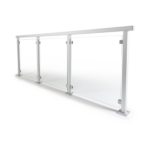
Gates and fences work best together when their positions, dimensions and safety features are planned as a whole. The fence defines the boundary, while the gate must allow convenient access and suit how the space is used.
The gate is also the moving part of the fence and is exposed to repeated use and loading. Unlike a fixed fence panel, it opens and closes each day, so its hinges, latch and posts need particular attention.
In this guide, we’ll go over where to place gate, how to choose the right width and opening direction, what to consider near the pool and driveway, and how the gate’s material and design can complement fence.
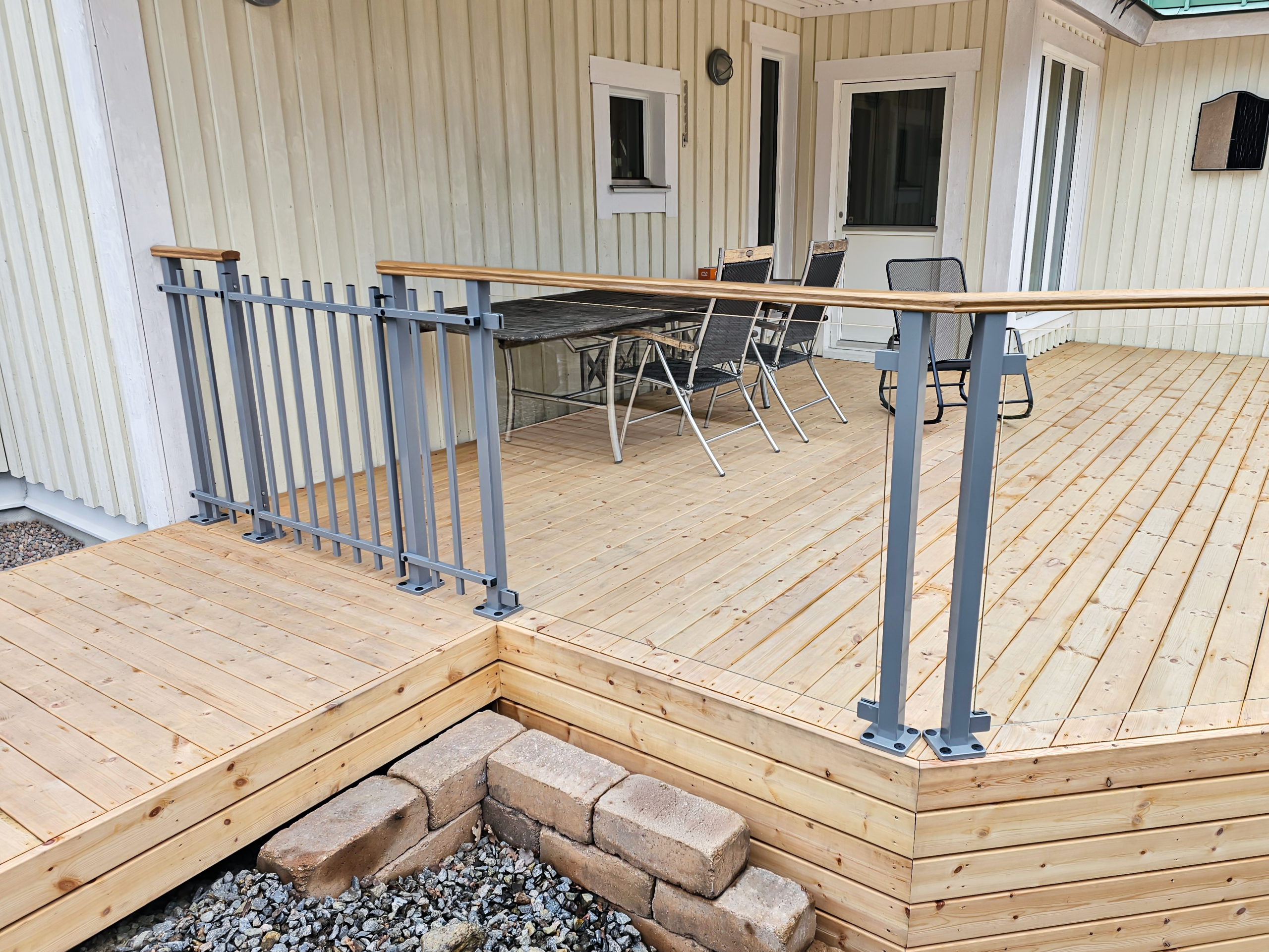
Where do you need a gate?
The location determines how wide the gate needs to be, what hardware is required, and how it should open. A gate at the entrance has completely different requirements than a gate by the driveway or the pool.
At the entrance and property boundary, gate must also work visually in harmony with the surrounding fence and gates, while a driveway gate primarily requires sufficient opening space and properly sized hardware.
| Location | Examples of measurements | What matters is |
|---|---|---|
| Entrance and property boundary | 90–120 cm wide | Should match fence in terms of material and colour |
| Driveway | 250–400 cm wide, double | Gate weight and hinge sizing |
| Pool area | 90–100 cm wide | Self-closing and locks out of reach |
| Deck with stairs | The height follows the railing | The same safety feature as the railing all around |
| Growing areas and kitchen gardens | 80–100 cm wide | Easy access where a lower gate is often sufficient |
The widths listed are examples for planning purposes. Choose gate dimensions based on the clear opening, the gate’s design, and how the space is used. For pools, the gate’s safety features must also be checked.
At the driveway
Double gate or sliding gate?
The choice depends primarily on how much free space there is in front of and to the side of the opening.
How can you make a gate fit with the fence?
The easiest way to achieve a cohesive look is when gate and fence use the same materials, colours, and rhythm. If, instead, you want gate to stand out, a clear and deliberate contrast works better than a colour or shape that only almost matches.
The choice of materials also affects how much maintenance the structure requires and which environment it is best suited for.
| Materials | Maintenance | Best for |
|---|---|---|
| Powder-coated aluminium | Wipe down as needed | Modern fence, decks, and pool areas |
| Forged aluminium | Wipe down as needed | Classic entrances and older homes |
| Pressure-treated wood | Oil or apply wood stain regularly | Rural gardens and growing areas |
| stainless steel, AISI 316 | Clean as needed | Coastal and other exposed locations |
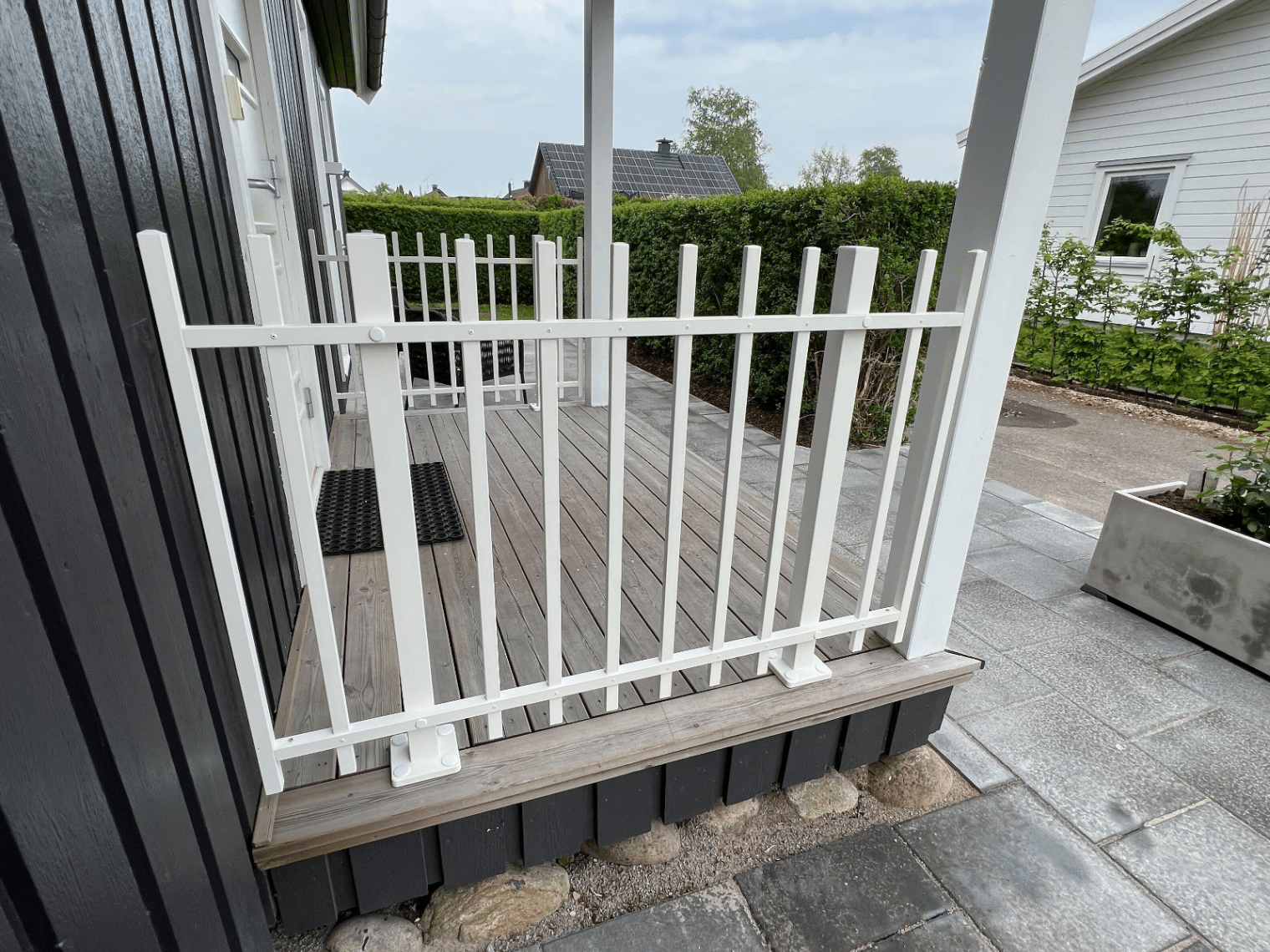
The visual style
Three details create a cohesive look
Materials
Make sure that the gate panels, posts, and fence follow the same basic design elements or a clearly consistent design language.
Colour
Use the same colour and texture when the pieces are meant to blend together. Two nearly identical colours are often perceived as a mistake.
Rhythm
Continue the fence’s slat spacing, vertical bars or decorative pattern across the gate so the overall design feels consistent.
Do you want to create contrast? Make the difference clear and intentional, rather than choosing a colour or shape that only almost matches.
What should a pool gate do?
A pool gate should be able to close and lock securely even if someone leaves it ajar. It should also open away from the water and be designed so that small children cannot easily open it or climb on it.
The gate is the moving part of the safety barrier and is therefore particularly important to check. It must be planned together with the other balustrades and barriers around the pool so the entire protective boundary works as one continuous system.
Check the pool gate
Four functions that need to work together
-
Self-closing
The gate leaf should return to the closed position without having to be pulled shut by hand. Test this function from both the fully and partially open positions.
-
Child-proof lock
The latch should be positioned and designed so that small children cannot open the gate. Make sure the latch catches the gate panel when it reaches the post.
-
Correct opening direction
The gate should open away from the pool rather than towards the water. Make sure there is enough clearance for it to open freely.
-
No climbing aid
Avoid horizontal slats, rails and other details that could be used as footholds on or near the gate.
What do you need to check regarding dimensions, hinges, and locks?
Check the clear opening, ground clearance, the weight of the gate leaf, the lock’s operation, and the gate posts’ fixing before determining the gate’s final dimensions. These factors determine whether the gate operates smoothly, can be adjusted, and functions reliably over time.
- Width Measure between posts
- Measure the clear opening between the gate posts, not the total length of the fence. The ordering dimensions must also take into account the clearance required for the hinges and locks.
- Ground clearance Usually 3–5 cm
- Leave some space between the bottom of the gate and the ground. Otherwise, the gate panel may start to scrape if frost, gravel, or uneven ground causes the level to change.
- Hinges Sized to suit the weight
- Choose hinges that are rated for the weight of the gate leaf. Adjustable hinges make it easier to realign the gate if posts or the ground shifts.
- Locks By function and location
- Magnetic locks are convenient for everyday use, while a drop-down latch provides a simple mechanical lock. Around a pool, the lock must be positioned and designed so that small children cannot open it gate.
- Posts Carry the entire gate leaf
- The gate post is subject to greater loads than the other fence posts and therefore needs a sturdier foundation fixing. The subsoil, the weight of the gate, and the post system determine how the foundation should be constructed.
What do you need to plan for a motorised gate?
For a motorised gate, the foundation, electrical system, freedom of movement, and safety features must be planned before the driveway is completed. The motor is installed later, but the conditions necessary for the installation must be in place from the very beginning.
Plan before starting the groundwork
Four components need to work together
-
Foundation
Gate posts and fixings must be sized to accommodate the gate's weight, movement, and wind loads.
-
Electrical supply and cable routes
Plan the cable conduits and the placement of the motor, control system, and safety equipment before the driveway is completed.
-
Freedom of movement
Check that the gate leaf can move along its entire path of travel without coming into contact with the ground, vehicles, or other obstacles.
-
Safe use
Plan for equipment that reduces the risk of pinching and stops movement if someone or something is in the danger zone.
When the gate is moving
Safety must be built into the design
Photocells, anti-trap protection and controls must be chosen to suit the gate type and installation. The gate must not continue moving when a person or obstacle is detected.
When the power goes out
Plan for manual opening
A manual disengagement mechanism allows the gate to be opened in the event of a power failure or operational disruption. It must be accessible to the user but protected against unauthorized use.
What should you check before ordering a gate?
Before ordering a gate, you should check the location, clear opening, opening direction, how gate fits with fence, hinges, ground clearance, and the gate posts’ fixing. This reduces the risk of incorrect measurements and of gate scraping the ground, not opening fully, or having improper clearance against posts.
Pre-order checklist
Seven things to check
-
Decide where to position the gate
Start with how you move through the garden and where a path is actually needed, rather than planning the gate solely from the shape of the plot.
-
Measure the clear opening between the gate posts
Measure between the finished gate posts and check the measurement at both the top and bottom before determining the gate width.
-
Check the direction in which the gate opens
Check on site to make sure the gate can be opened without hedges, steps, downpipes, or other obstacles getting in the way.
-
Match the gate to the fence
Let the material, colour, slats, or ornamentation follow the fence’s lines if gate and fence are to have a cohesive look.
-
Select hinges based on the gate's weight
The hinges must be designed to accommodate the weight and use of the gate panel. For pool gates, a solution is also needed that provides reliable self-closing.
-
Check the gate's ground clearance
Normally, leave about 3–5 centimetres between the bottom edge of the gate and the ground, and take into account any slope, gravel, and changes in ground level.
-
Check the gate-post fixings
The gate posts support both the weight and movement of the gate panel and must therefore be sized and anchored to withstand the load that the gate subjects them to.
In a nutshell
The right gate starts with the right conditions on site. Be sure to check the dimensions of the opening, the gate’s movement, and the posts’ fixing, above all, before placing your order—after that, the materials, hardware, and design can be tailored to fence and the surroundings.
Planning a fence and gate?
Explore our current range of fences and gates, with product information, dimensions and designs in one place.
What do you need to know about gates and fences?
Here are brief answers to common questions about gate width, opening direction, clearance, locks, pool gates, and adjusting gate, and gate posts.
How wide should a gate be?
A pedestrian gate is often about 90–120 centimetres wide. For a driveway, a significantly wider opening is needed, often about 250–400 centimetres in total. Base your decision on the clear passage between posts and how the opening will be used.
Which way should a gate be opened?
A gate should open in the direction that allows for unobstructed passage and sufficient room to turn. It should not open onto a pavement, street, or other area outside the property. Near a pool, gate it should open away from the water.
Does a gate by a swimming pool need to be self-closing?
Yes, a pool gate should be self-closing and have a lock that small children cannot open. The self-closing feature reduces the risk of the gate being left open. Check regularly to make sure that both the hinges and the lock work from different opening positions.
How much space does a gate need between posts?
The gate panel needs clearance for hinges, locks, and adjustment, but the exact measurement depends on the gate’s design. Therefore, follow the measurement instructions for the specific system and do not subtract a general standard measurement on your own.
Do gate and fence have to be made of the same material?
No. Gate and fence do not have to be made of the same material, but the same colour, proportions, and design language often create a more cohesive look. If gate is to differ, a clear and deliberate contrast works better than materials or colours that merely almost match.
Which lock is compatible with a gate?
Choose a gate lock based on how the gate is used. A magnetic lock or gate lock is often suitable for a single gate, while a double gate may also require a latch that holds one gate panel in place. For a pool, the lock must be designed and positioned so that small children cannot open it.
Why might a gate sag or hang crooked?
A gate may start to hang crooked if the hinges need adjusting, the gate post has shifted, or the gate panel has started to sag. First, check that the post is vertical. If the post is stable, the gate can often be straightened using adjustable hinges.