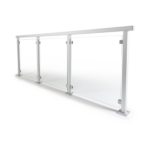
Toughened glass is heat-treated to make it stronger, while laminated glass has a film that holds the glass together if it breaks. Frosted and tinted glass, on the other hand, describe the glass’s appearance and how much light and visibility it allows—they do not, in and of themselves, indicate what safety features the glass has.
In a balustrade, the glass’s structure must be adapted to the railing’s design, its location, and the risk posed if the glass breaks. Where falls through the glass surface must be prevented, the glass’s ability to remain intact after breaking becomes particularly important.
A glass can therefore, for example, be both toughened and laminated and at the same time be clear, frosted, or tinted. The safety feature and the visual appearance are two separate choices that need to be kept distinct.
Toughened vs laminated safety glass: what is the difference?
Toughening changes the strength of the glass and how it breaks, while lamination holds the fragments together with an interlayer. In a glass balustrade, glass may be both toughened and laminated when the structure needs both properties.
| Property | Toughened glass | Laminated glass |
|---|---|---|
| Structure | The glass is heat-treated so that it has different strength properties than ordinary glass. | Two or more glass panels are bonded together with an interlayer that holds the glass together. |
| Main property | Toughening makes the glass more resistant to mechanical and thermal stress. | The lamination helps the glass panes and shards to stay together if the glass breaks. |
| When broken | The glass usually breaks into many small pieces rather than large, sharp shards. | The intermediate layer holds a large portion of the glass in place even after the glass panes have cracked. |
| After breakage | The glass panel may cease to act as a continuous barrier when it breaks. | The glass panel may retain a continuous residual structure because the fragments are held in place. |
| Can they be combined? | Yes. Toughened glass can also be laminated. | Yes. A laminated glass can be made up of toughened glass panels. |
When is toughened laminated glass needed in a balustrade?
Toughened laminated glass combines the increased strength provided by tempering with the ability of lamination to hold the glass together after breakage. Whether this combination is necessary depends on the railing’s design, location, and load—not on any single factor.
Two situations in which the structure of the glass needs to be carefully assessed
When glass plays a more significant role
In a frameless glass balustrade, a greater share of the load is transferred through the glass and base channel than in a structure where posts also carry the load. The glass construction, thickness and fixings must therefore be assessed as part of the complete system.
When the structure is also movable
In a height-adjustable railing, the glass must work in conjunction with a moving structure. The type of glass therefore cannot be selected independently of the mechanism, the fixings and the load the railing is designed to handle.
Which safety glass is best suited for which environment?
The setting provides useful clues, but does not determine the glass type on its own. On a balcony, for example, the risk of falling is particularly important, whereas an indoor partition without a fall risk may need to be assessed mainly for the risk of impact. The balustrade design, location of the glass and expected loads must always be considered together.
| Environment | Most important factors to consider | What this means for choosing glass |
|---|---|---|
| Deck close to the ground | Risk of collision, the railing's design, and the actual risk of falling at the edge. | The glass must be selected based on the safety function that the structure is intended to provide. A low installation height does not automatically mean that a particular type of glass is always the right choice. |
| Deck with a risk of falling | What happens if the glass breaks and whether the panel forms part of the fall protection. | The ability to hold together after breakage is particularly important and must be assessed alongside the fixings and the rest of the balustrade. |
| Balcony | Risk of falling, dynamic impact, the placement of the glass, and how the load is transferred through the railing. | The safety design of the glass must be developed as part of the overall fall protection, rather than being selected solely based on glass thickness. |
| Indoor Staircase | Risk of falling on the stairs, risk of collision, and if the glass serves as a railing infill or a partition. | The glass’s ability to limit the risk of injury in the event of breakage and in the event of a potential fall must be assessed based on the specific location. |
| Room divider | The risk of people walking into or falling against the glass, as well as the size and location of the glass. | Here, reducing the risk of cuts in a collision is often more relevant than fall protection. |
| Around the pool | How the area is used, the risk of collisions, children's safety, and whether the glass also serves as a railing infill where there is a difference in level. | The choice of glass must be adapted to the actual design and risk profile. The pool environment itself does not automatically dictate a specific type of glass. |
| Frameless balustrade | How the glass carries and transfers loads to the base channel and the underlying structure. | Glass type, construction and thickness must be specified together with the base channel, fixings and expected loads. |
How thick should balustrade glass be?
There is no single glass thickness that works for all railings. The thickness must be adapted to the railing's design, fixing, and the load the glass must withstand.
Part of the assessment concerns dynamic impact, that is, the load that can occur when a person, for example, falls, runs, or otherwise strikes the glass with force. Therefore, the thickness and construction of the glass must be assessed in conjunction with the entire railing structure.
Three things need to be evaluated together
- The design of the balustrade
- Post-supported and frameless balustrades transfer loads differently. The same glass thickness should therefore not be treated as a universal starting point for both systems.
- Fixing
- The glass must work with the posts, base channel, glass clamps or other fixings. How the glass is supported affects the required construction.
- The load
- The glass and the balustrade structure must be designed to withstand the loads that may occur where the railing is to be installed, including the impact of people against the glass surface.

Are frosted and tinted glass as safe as clear glass?
Yes, provided the glass has the same safety construction and is suitable for the same balustrade system. Clear, frosted, tinted and smoked glass mainly describe appearance, light transmission and privacy – not whether the glass is toughened, laminated or both.
- The surface has an effect
- Natural light, privacy, and the visual appearance of the railing.
- Safety is determined by
- The glass's construction, thickness, fixing, and the load that the railing structure must withstand.
How do you choose the right safety glass for a balustrade?
Start by assessing where the glass will be installed, what the risk of falling is, and how the railing is constructed. Then you can check the glass’s safety features, thickness, and fixings before choosing between clear, frosted, or tinted options.
Check this before ordering glass
-
Assess the location and the risk of falling
Check where the glass is located and what might happen if someone bumps into or falls against the glass surface. The height of fall is an important part of the assessment, but must be considered in conjunction with the glass’s location and the railing’s function.
-
Decide how the railing should be constructed
Decide whether the glass will be used in a post-supported, frameless or another type of balustrade system. The design affects how loads are carried and the requirements for the glass and fixings.
-
Check whether a permit or approval is required
If the railing is part of, for example, a new balcony, rooftop terrace, or other building modification, permits or approvals may be required. Check which rules and procedures apply in your area before ordering the final solution.
-
Choose the appropriate safety-glass construction
Consider whether the glass should be toughened, laminated or both. The choice must reflect how the glass and the complete balustrade are intended to perform under significant impact or following breakage.
-
Check the glass thickness and fixings
The glass thickness must suit the specific structure and loads. Check it alongside the posts, base channel, glass clamps or other fixing method.
-
Choose clear, frosted, or tinted glass
Once the required safety-glass construction has been established, choose the appearance to suit the desired daylight, privacy and overall look. These visual choices do not replace the technical considerations above.
Which glass balustrade is right for your project?
Once the location, risk of falling and balustrade construction have been assessed, you can compare different glass balustrades and contact customer service for guidance before ordering.
What should you know about safety glass for balustrades?
The most important thing is to distinguish between the glass’s safety features and its appearance. Tempering, lamination, thickness, and fixing affect how the glass functions in the railing, while frosted and tinted glass primarily affect light, privacy and appearance.
What is the difference between toughened and laminated glass?
Toughened glass is heat-treated and normally breaks into many small fragments, while “ laminated ” glass has an intermediate layer that holds the glass together after it breaks. These two properties can also be combined in “ toughened ”laminated glass.
What type of glass is needed when there is a risk of falling?
Where there is a risk of falling through a glass surface, the glass, fixing, and railing structure must be designed to prevent falls even under dynamic loads. A laminated structure can hold the glass together after breakage, but the exact solution depends on the design.
Is toughened glass enough for indoor use?
It is not determined by whether the glass is installed indoors or outdoors. Location, the risk of falling, the risk of collision, and the railing’s design determine which safety configuration is needed.
How thick should the glass in a railing be?
There is no universal glass thickness for all railings. The dimensions of the glass, fixings, the railing design, and the load that the solution must withstand must be evaluated together.
Is frosted glass just as safe as clear glass?
Yes, if the glass has the same safety structure and is designed for the same application. Frosting or tinting does not in itself affect whether the glass is “ toughened,” “ laminated,” or a combination of both.
Why must frameless glass balustrades be carefully designed for the required loads?
In a frameless balustrade, the load passes through the glass and base channel without posts to help carry it. The glass, channel and fixings must therefore be designed and assessed together.
What does “dynamic impact on a glass balustrade” mean?
This refers to the impact that can occur when a person, for example, falls, runs, or otherwise strikes the glass with force. When the glass is part of a fall protection system, both the glass surface and fixings must be able to withstand such impacts.