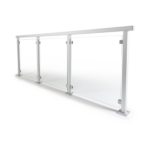
Fence and hedges work best together as privacy screen, where fence provides a solid and immediate screen where visibility is greatest, while the hedge adds greenery, depth, and a softer feel to the areas where there is space.
A fence provides an immediate screen and takes up relatively little width. A hedge takes time to grow but can create a softer, more natural boundary. The two do not need to cover the same area: choose a combination that suits your garden.
How to position a fence and a hedge depends on the size of your lot, the direction from which people can see into your property, and how you want to maintain privacy throughout the year. Here, we’ll go over the differences between them, how you can combine them, and what you need to keep in mind when the hedge becomes sparser during the winter months.
Which privacy screen suits different parts of your garden?
Fencing works best where you need privacy straight away or have limited space. A hedge is useful where there is room to grow and you want a softer, greener boundary. A combination may work best in different parts of the same garden.
The table is simplified, but it illustrates an important principle: the built boundary rarely needs to run around the entire property. It is often sufficient to install fencing where privacy is needed most and let a hedge or other vegetation take over the rest.
| Location | Common problem | A solution that often works |
|---|---|---|
| Facing the street or the pavement | Privacy and noise | Fence, preferably with a hedge in front |
| Toward the neighbour's deck | Overlooking at seated eye level | Fencing or a more closely spaced screen |
| Narrow plot | The hedge takes up too much space | Fence with climbing plants |
| Large garden | Needs a softer boundary | Hedge, with fence on vulnerable sections |
| The winter months | Deciduous hedges become sparser | Fencing provides the initial screening |
| Newly landscaped plot | The vegetation has not yet had time to establish itself | Immediate screening from a fence, with a hedge growing in over time |
Where can people see in from – and where do you actually need screening?
Start with the areas where you actually spend time and identify which sightlines feel intrusive. The view often comes from one or two distinct directions, not from all along the property boundary.
So sit down at the dining area, in a lounge chair, or on the steps, and look toward your neighbour’s patio, nearby windows, the street, or the walkway. It is from that height and those vantage points that the need for privacy should be assessed.
Once you have identified the directions from which your garden is overlooked, you can concentrate the privacy screening in those areas rather than enclosing the entire plot. This may reduce how much fencing you need while allowing more open views elsewhere.
Fence or hedge: what is the difference when it comes to privacy?
A fence provides a clear boundary and privacy right away, while a hedge takes time to grow but adds greenery, depth, and a softer transition in the garden. The combination provides a consistent basic level of privacy while allowing the vegetation to develop over time.
- Fence
- It takes full effect immediately. It reaches the height you’ve chosen, and the boundary is clear from day one. It also takes up relatively little space widthwise, which can be an advantage on smaller plots and near patios.
- Hedge
- Adds greenery, depth, and a softer boundary. A newly planted hedge, on the other hand, takes several years to become dense and typically takes up more space in width than a fence.
- Combination
- The fence provides privacy from the start and maintains a basic level of screening all year, while the hedge adds greenery and softens the boundary as it grows.
- Climbing plants
- Provides greenery without taking up as much space as a hedge. A slatted fence can serve as a support for the plants and is therefore particularly well-suited for narrow lots or passageways.
How do a fence, a hedge, and a combination of the two differ in practice?
Fencing gives the quickest and most predictable privacy. A hedge takes more time and space to establish but adds greenery and can help soften sound. Combining the two offers immediate screening together with a greener appearance over time.
| Property | Fence | Hedge | Combination |
|---|---|---|---|
| Impact in the first year | Full | Limited | Full |
| The winter months | Unchanged | More open if the hedge is deciduous | Consistent basic level of privacy |
| Space required across the width | Small | Larger | Largest |
| Care | Low to moderate | Regular trimming | Care of both parts |
| Sound attenuation | Limited | Good | Good |
Should the hedge go in front of or behind the fence?
The hedge can be placed both in front of and behind the fence. The choice depends mainly on what you want to see from your own garden: greenery closest to the patio, or fence as a distinct part of the boundary.
Here, we mean the front and back as seen from your own property. Regardless of the location, there needs to be enough space to access both the hedge and fence when they need to be maintained.
Hedge in front of the fence
Place the hedge on your side of fence. That way, the greenery will be what you see closest to you from the garden, while your neighbour or the street will mainly see fence.
This arrangement often works well when the fence is placed close to property boundary and is primarily intended to provide a solid foundation for privacy screen. At the same time, Fence can serve as a serene backdrop behind the vegetation.
Hedge behind the fence
Place the hedge behind the fence as seen from your garden. That way, fence will serve as a clear boundary closest to you, while the greenery softens the look behind it.
This is ideal when the fence’s shape, colour, or slats is an important part of the garden’s overall look and should therefore be visible from the patio.
Can climbing plants provide privacy when space is limited?
Yes. Climbing plants can add greenery and create a denser privacy screen without taking up as much ground space as a full-grown hedge, which makes them particularly useful on narrow plots and near patios.
In a smaller space, a hedge may require more width than is available. In that case, planting along a fence can create a softer look without having to move the boundary further onto the property.
A slatted fence can also serve as part of the support system for climbing plants. However, how the plant needs to be tied up or trained depends on the variety and how it grows.
How do a fence and hedge work together to provide privacy in winter?
A fence provides much the same level of screening throughout the year, whereas a deciduous hedge becomes considerably more open when its leaves fall. If privacy is important in winter too, it is sensible not to rely on the hedge alone.
The difference is often most noticeable in late autumn and winter. A patio that feels completely secluded in the summer can become more open as the foliage thins out, while the darkness makes lit-up windows and rooms more visible from the outside.
Combining a fence and hedge provides more consistent privacy throughout the year. The fence gives an immediate screen, including when the hedge loses its leaves, while the hedge adds greenery in the growing season.
Evergreen hedges can be an option if you want to maintain greenery even during the winter. How dense they become and how well they establish themselves depend, among other things, on the plant variety, soil, and location.
What do you need to consider before planning a fence and hedge?
Before deciding on the height and location, you need to consider how the boundary will function in everyday life. Be sure to plan for varying heights, access for maintenance, applicable rules, and how the solution will affect your neighbour.
- Adjust the height as needed
- The boundary does not need to be the same height along the entire property. Where overlooking is minimal, lower sections can allow more light in and create a more open feel, while taller sections can be concentrated along the most exposed sightlines.
- Plan for maintenance from your side of the boundary
- fence, and hedges should all be able to be trimmed, painted, and maintained without you having to step onto your neighbour’s property. Therefore, keep access in mind when deciding on their placement.
- Check which rules apply
- Height, density, and location can affect how a built barrier is assessed, and local regulations may also play a role. Hedges and other plants are not always treated in the same way as fences, solid boundary walls or other built structures.
- Talk to your neighbour well in advance
- Early communication can reduce the risk of misunderstandings regarding height, placement, and maintenance. In some cases, it is also possible to find a solution that works better for both properties.
How do you plan a fence and hedge for privacy?
Start by identifying your needs, and then consider sightlines, height, placement, maintenance, and regulations before deciding on the final solution. This will make it easier to use fencing where it is really needed and let the hedge or other greenery take over the rest.
Check these six points
-
Identify unwanted sightlines
Check whether people can see into your space from the places where you actually sit and spend time. Mark which directions need to be screened off and which parts of the property can be more open.
-
Determine where the physical barrier is needed
Start by considering where your garden is overlooked rather than automatically planning fencing along the whole boundary. Concentrate screening where it makes the most difference.
-
Adjust the height to fit the space
Higher sections may be needed where overlooking is greatest, while lower sections can preserve more light and space. Therefore, the same height does not need to be used everywhere.
-
Decide where to plant the hedge
Decide whether the hedge should be on your side of the fence or behind it as seen from the garden. Be sure to leave enough space for trimming and maintenance.
-
Check regulations and local conditions
Find out what the rules are regarding the intended height and location. Built barriers and hedges can be assessed in different ways, and local regulations may affect the solution.
-
Check with your neighbour to confirm the location
If the boundary is close to property boundary, it’s a good idea to discuss the location, height, and future maintenance before work begins.
Do you need help choosing the right fence for privacy?
Once you know where you want to block the view, it becomes easier to choose the height, design, and how the fence can be combined with a hedge or other greenery.
Frequently asked questions about using fences and hedges for privacy
Here are brief answers to some common questions about placement, spacing, winter hardiness, and how fencing and plants can be combined.
Should the hedge be in front of or behind the fence?
Both placements work. With the hedge in front of fence, you’ll mainly see the greenery from your own garden, while fence will be more visible if the hedge is placed behind it. Choose based on the look you want and how you need to access both areas for maintenance.
How close to a fence can you plant a hedge?
It depends on the type of hedge and how wide it will become as it grows. Leave enough space to be able to trim the back of the hedge and access the parts of the fence that need maintenance.
Do you need privacy screening along the entire property boundary?
No, not always. The view often comes from just a few distinct directions. By screening off the most exposed sightlines, the rest of the plot can be left more open to allow for more light and space.
Can climbing plants be used instead of a hedge?
Yes, especially where space is limited. Climbing plants can add greenery along a fence without taking up as much width as a full-grown hedge. How the plant needs to be supported depends on the variety you choose.
Which type of privacy screening works best in winter?
A fence provides more predictable privacy year-round, since a deciduous hedge becomes sparser during the winter months. A combination of the two allows the fence to provide the basic level of privacy, while the hedge adds greenery when it is dense.
What regulations should you check before building a fence near a property boundary?
Height, density, and location can affect how a constructed barrier is assessed, and local regulations may also play a role. Therefore, check the most current information from the relevant authority and determine which local regulations apply to the proposed solution.