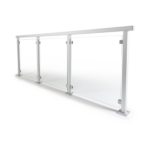
Privacy screen Blocking the view from your neighbour's patio works best when you screen off the specific line of sight that's actually bothering you, rather than building a solid barrier around the entire patio.
Two decks located close to each other may allow you to look directly into each other’s outdoor spaces. While a tall screen surrounding the entire patio does provide more privacy, it can also block out light and create a cramped feeling. Often, a shorter, properly placed section is sufficient.
Here, we'll walk you through how to identify the unwanted line of sight, choose the height and placement based on the situation, and what you need to check before you start building.

Where does the view of the deck come from?
The view usually comes from a specific direction: a neighbour’s deck, a window, a walkway, or a higher level. That’s why you rarely need to screen off the entire property boundary.
Start by identifying where your lines of sight actually intersect. Differences in elevation, distance, and how the outdoor spaces are used all affect which type of screening works best.
| Situation | Common problem | A solution that often works |
|---|---|---|
| The neighbour's deck on the same level | You can see each other when you're sitting down | A screen positioned where the lines of sight meet |
| The neighbour's deck higher up | Overlooking from above | A taller screen or shield placed closer to the seating area |
| The neighbour's window facing the patio | Visibility even when the deck isn't in use | A permanent barrier that works year-round |
| Terraced houses with a shared boundary | Very little space between the patios | A narrow, targeted solution that takes up little depth |
| Short distance between the houses | A solid screen may reduce the amount of natural light. | A more open solution that blocks the view but lets light through |
| Overlooking around the dining area only | The problem is limited to a small part of the deck | A short section instead of a partition along the entire side |
So the most important thing is not how large the garden is, but from which direction the view comes and at what height the lines of sight meet.
How do you test the line of sight before choosing a privacy screen?
Test the patio from the spots where you actually sit and move around. That way, you’ll see where people’s eyes meet and can determine which area needs to be screened off before you decide on the height or width of the privacy screen.
Check the line of sight from four positions
-
Sit where you usually sit
Start at the dining table, the sofa set, or the lounge chair. Look toward your neighbour’s patio and note the direction from which you feel most exposed.
-
Try it standing up, too
Stand up and check the same direction again. The line of sight changes with eye level, so a screen that works when you're sitting may not provide the same coverage when you're standing.
-
Identify where the overlooking comes from
Note whether the view comes from a neighbour’s deck, a window, a walkway, or a higher level. Also indicate how much of the deck is actually affected.
-
Check the line of sight from the other side
Feel free to ask someone to stand roughly where your neighbour's seat is while you sit on your side. That will make it easier to see what height and width are actually needed.
The test often shows that only a short section needs to be screened off. The more precisely you identify the line of sight, the less you'll need to build.
How tall does privacy screen need to be?
The privacy screen needs to be tall enough to block the line of sight that is intrusive. For overlooking between two outdoor areas at roughly the same level, a lower height is therefore often sufficient when you are seated, while overlooking when standing requires more screening.
The dimensions below are practical examples for assessing the line of sight; they are not general rules for the “ balustrade height ” or planning permission. The placement is at least as important as the total height.
Limited shielding
A height of around 110 cm can block a low line of sight or create a clearer boundary between outdoor seating areas, but is usually not enough to hide two people sitting across from each other.
Screening between seating areas
A height of around 150 cm can often block the line of sight when two patios are close together and people are seated. This provides more privacy without automatically creating the same enclosed feeling as a much taller screen.
More complete privacy screening
At around 180 cm or taller, it can also block the view of people standing up. At the same time, there’s a greater risk that the screen will block light and make the patio feel more enclosed, especially if it runs along an entire side.
Often, the best solution is to use the taller screen only where the view into the space is most noticeable, while leaving the rest of the deck more open.
Should privacy screen be transparent or opaque?
Choose a denser screen when maximum privacy is most important. If the patios are close together, angled slats or frosted glass is often a better choice when you want to block the line of sight without blocking as much light.
A privacy screen can therefore serve the same basic function in different ways, depending on how much light, air, and privacy you want to maintain.
| Property | Solid timber fence or screen | Angled slats | Frosted glass |
|---|---|---|---|
| Privacy | Very high | High from the selected direction | High |
| Light transmission | Low | Good | Very good |
| Line of sight | Blocks from multiple directions | Can provide targeted screening | Blocks the view across the entire surface |
| Appearance | More compact and solid | Light and textured | Bright and visually light |
| Maintenance | Depends on the material and surface treatment | Depends on the material and surface treatment | Clean as needed |
What should you discuss with your neighbour?
Show where the privacy screen is supposed to be placed, roughly how tall it will be, and how close it will be. This will make it easier for the neighbour to understand how the solution will actually affect their own patio.
A quick call before you place your order can also reduce the risk of misunderstandings regarding placement, lighting, and how much of the property boundary should be screened off.
It may also turn out that the neighbour has the same line of sight from their side. In that case, it is sometimes possible to find a location or configuration that provides better privacy for both patios without the screen having to be larger than necessary.
What do you need to figure out before choosing a privacy screen?
Once the line of sight, height, and placement have been determined, the choice becomes easier. At that point, you’ll need to pay particular attention to the dimensions, the surface, and how much light and privacy you want.
- Width: the length of the deck that needs to be screened off.
- Height: whether it needs to screen views of people sitting or standing, or from a particular direction.
- Placement: whether the shelter should be placed on the deck, at the edge, or along a shorter side.
- Background: var stolpar eller fästen kan monteras på ett stabilt sätt.
- More privacy: Choose a denser option or a taller section where overlooking is greatest.
- More light: Choose slats or frosted glass instead of a completely solid privacy screen.
- More open feel: screen only the side where unwanted views cross.
- Consistent design: Coordinate privacy screen with the railing, facade, or other details on the deck.
What do you need to check before building a privacy screen?
Determine how much of the area actually needs to be screened, at what height the line of sight is blocked, and what rules apply to its placement. Also consider how the solution will function when the vegetation disappears during the winter months.
Check these four points
-
Block the view where it's actually a problem
Start at the dining area, the sofa group, or the side where the line of sight is clearest. Often, a shorter section is enough instead of a screen running the entire length of the deck.
-
Select the height based on the line of sight
A taller screen provides more privacy but can also reduce the amount of light entering and make the patio feel more enclosed. Therefore, base your decision on the height needed where overlooking actually occurs.
-
Check the rules for fences, screens and property boundaries
Check whether privacy screen can be considered a fence and what rules apply regarding height and placement, especially near property boundary.
-
Think about how the protection works year-round
Hedges and other vegetation can provide good privacy during the summer but significantly less protection once the leaves fall. If you need privacy year-round, you should take this into account as early as the planning and design phase.
Start with the sight line; choose only the height and length you need and check the placement guidelines before you build.
Which privacy screen is best suited for your deck?
Start by considering the line of sight, the dimensions, and how much light you want to let in. Our customer service team can help you compare your options and find a solution that works for your space.
What do you need to know about the privacy screen against your neighbour?
The most common questions concern height, property boundary, light, and how much of the deck actually needs to be screened off. Here are brief answers to the most important questions.
How high does the privacy screen need to be in relation to the neighbour's deck?
It depends on the line of sight. If the decks are at roughly the same level, a height of about 150 cm is often enough to block the view when you’re sitting. If the screen is also meant to block the view of people standing, it may need to be taller.
Do I have to ask my neighbour?
It depends on where privacy screen is located and what regulations apply where you live. Near property boundary, your neighbour’s consent or other requirements may apply, so check the conditions before you build.
What height rules apply at a property boundary?
There is no single height that applies in all situations and in all markets. Height, density, location, and distance to the property boundary can affect the applicable requirements, so always check the current local regulations before building.
Can privacy screen steal the spotlight from its neighbour?
Yes, especially if the screening is tall and dense. If the patios are close to each other, a shorter section, angled slats or a material that lets more light through can reduce the impact.
Do I need to enclose the whole deck?
No. Often, a shorter section where the line of sight is clearest is enough. That way, you get privacy where you need it, while the rest of the deck can remain more open and brighter.
Do plants like privacy screen work against the neighbour?
Yes, plants can provide good privacy during parts of the year. Deciduous plants, however, offer less protection during the winter, so if you want privacy year-round, a permanent privacy screen can provide more consistent privacy.