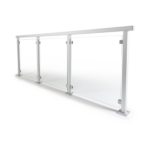
When building fence for your patio, you should start by deciding what function fence it should serve and then choose the materials. Aluminium and glass are good choices when you want to keep maintenance to a minimum, wire when the view is important, and wood when you want a more classic look and are willing to put in more ongoing maintenance.
Also consider whether the fence should serve as fall protection, reduce overlooking, provide shelter from the wind, or—above all—frame the outdoor space. This affects the height, density, construction, and which material is best suited for your specific patio.
In this guide, we'll go over material choices for different weather conditions, safety and maintenance, as well as what you need to consider when a deck fence is also intended to serve as a railing.
What is fence meant to solve?
Start by determining the purpose of the fence on the patio. A fence intended primarily to provide fall protection needs to be designed differently than a solution for privacy, wind protection, or an unobstructed view—and there may be multiple needs in the same outdoor space.
| Needs | Common problem | A solution that often works |
|---|---|---|
| Fall protection | The deck is high up | Balustrade suited to the risk of falling at the location |
| Privacy screen | The neighbour can see right inside | Frosted glass or closely spaced slats |
| Windbreak | Wind makes the surface unusable | Clear glass |
| Preserve the view | The railing blocks the view | Wire balustrade or frameless glass |
| Child safety | Structures for climbing | Vertical slats and small openings |
| Minimal maintenance | Wood requires periodic surface treatment | Aluminium or glass |
What's the best material for a fence on the patio?
Glass and aluminium are good choices when you want to keep maintenance to a minimum, while wire creates an open look, and wood requires more ongoing maintenance. If the view is important, a glass balustrade for the patio might be an option, since it frames the outdoor space without creating the same visual barrier as a denser fence.
- Glass
- Clear glass preserves the view, frosted glass offers more privacy while still allowing light to enter, and tinted glass can reduce glare. Glass railings can be designed with posts or as more open, post-free solutions, depending on balustrade system and the site’s conditions.
- Aluminium
- Aluminium is a good choice when you want a fence that requires little future maintenance. Powder-coated profiles are designed for outdoor use and allow you to choose a colour and a style that complement both your home and your patio.
- Wire
- Wire creates a light and airy look and has relatively little impact on the view from a distance. It is therefore particularly well-suited for decks where the surroundings should remain a distinct part of the experience.
- Wood
- Wood has a classic, warm look but requires regular painting, oiling, or other surface treatment to withstand the weather and moisture. It’s best suited when you prioritise the feel of wood and are willing to perform more frequent maintenance.
How high should a fence or balustrade on a deck be?
The balustrade height needs to be appropriate for the deck’s drop height, how the space is used and the protection needed to reduce the risk of falling. It is therefore important to assess both the height and the balustrade’s construction before deciding which design is suitable.
When younger children can be on the premises
What do you need to check to ensure child safety?
A child-safe railing must prevent climbing and reduce the risk of children falling through or getting stuck in the structure. Therefore, inspect the entire railing, including openings and connections.
Prevent climbing
Avoid features that make the railing easy to climb. Horizontal sections and objects near the railing can give children a way to climb higher.
Check the openings
The spacing between slats, glass panels, and other parts must be designed so that children are not at risk of squeezing through or getting stuck.
Check the bottom edge
Check the distance between the bottom edge of the railing and the deck floor. Openings near the floor also need to be evaluated from a child safety perspective.
Avoid the risk of getting stuck
Pay special attention to openings at corners, joints, and the top of the railing. The design must not create spaces where a child could get their head or neck stuck.
How can decking balustrades provide both shelter from the wind and privacy?
A deck fence can provide both windbreak and privacy screen by choosing the right material and density based on which side of the deck you want to protect. Frosted glass shields against both wind and prying eyes without blocking out natural light, while denser slats provides more privacy but still allows some air to pass through.
If wind is the biggest problem, a windbreak on the balcony can be designed to be more open toward the view and more dense toward the prevailing wind direction. The same principle can be applied to prevent people from looking in from neighbours’ properties, the street, or nearby patios.
Windbreak with an unobstructed view
Clear glass shelters from the wind while maintaining views through the balustrade. Slats with closer spacing can reduce overlooking, but the design must take account of any fall-protection function.
Privacy without losing natural light
Frosted glass reduces overlooking without shutting out daylight. Closer-spaced slats provide more privacy, but they also change how much light and air can pass through.
Combine the features
Frosted glass in the lower section and clear glass above can improve privacy at seated height while retaining views and providing wind shelter.
Should you build the deck fencing yourself or choose a ready-made system?
Building it yourself is best when you want a lot of freedom, are used to working with wood, and can spend more time on measuring, cutting, and fixing. A ready-made system is better when you want to reduce the preparatory work and have posts, the filling, and other parts coordinated from the start.
| Aspect | Do-It-Yourself | Complete system |
|---|---|---|
| Cost of materials | It could be lower, especially if you're building with wood | Higher purchase cost, but the parts are compatible |
| Time required | More time for planning, cutting, and customisation | Less preparatory work when the parts are tailored to the system |
| Design | You are responsible for the design, fixing and construction | You start with the system's components and assembly instructions |
| Maintenance | May become larger, especially with painted or untreated wood | Can be kept down using, for example, aluminium and glass |
| Customisation | Great flexibility when building the structure from the ground up | Customisation takes place within the system's dimensions and available options |
The choice, then, comes down mainly to how much of the construction you want to do yourself. Wood offers great freedom for those building from scratch, while a ready-made balustrade system can reduce the work involved in getting the various parts to fit together before assembly.
What should you check before ordering a fence for your deck?
Check the drop height, intended function, materials and dimensions before ordering. This reduces the risk of having to make changes later.
Six things to check before choosing a fence
-
Have you measured drop height along the entire length of the deck?
Take measurements at several points, especially if the ground slopes. The risk of falling can vary along the same side of the deck.
-
What else should the fence provide besides safety?
Consider whether you also need windbreak, privacy screen, or want to preserve as much of the view as possible.
-
How much maintenance are you prepared to do?
Wood requires more frequent care, while aluminium and glass typically require less maintenance over time.
-
Are the height and design adapted to the risk of falling?
Base your decision on how the deck is used and how large drop height it is, not on a general standard measurement.
-
Does the balustrade need to be child-safe?
If young children are allowed on the deck, openings and the structure must be designed so that the railing prevents climbing, falling through, and becoming trapped.
-
Did you take a control measurement before placing your order?
Measure the actual areas where the fence will be installed and check the corners, level differences, and mounting points before ordering a custom-fit product.
Which fence is best suited for your deck?
The best-su fence e is the one that matches the balcony’s fall risk, function, and dimensions. Once you know whether you need fall protection, windbreak, privacy screen, or a more open enclosure, it becomes easier to choose the right material and design.
What should you know before building a fence for a deck?
Here you'll find brief answers to common questions about building permits, views, maintenance, glass, and dimensions. These answers will help you choose a solution that suits the conditions of your deck.
Do I need a building permit to install a fence on my deck?
Planning permission may be required depending on the fence’s height, density, and location. The design and height of the deck may also affect the assessment. Therefore, check the requirements for your property before you begin construction.
Which type of fence is best if I want to keep the view?
Clear glass and wire are two options when the view is important. Glass provides a continuous, transparent surface and can also shield against the wind, while wire creates a light and airy look with minimal visual impact from a distance.
Which material requires the least maintenance on the deck?
Aluminium and glass are good options when you want to keep maintenance to a minimum. Aluminium typically does not require repeated painting or oiling, while glass mainly needs to be cleaned. Wood usually requires more ongoing surface treatment to maintain its appearance over time.
What type of glass should I choose for a fence or a railing on the patio?
When the glass is also intended to serve as fall protection, the entire railing structure must be designed to fulfil this safety function. Laminated safety glass is a common choice because the panes stay together if the glass breaks. Clear glass is suitable when the view is important, while frosted glass provides more privacy and tinted glass can reduce glare.
Can a deck fence provide privacy without blocking the light?
Yes. Frosted glass reduces overlooking but still lets daylight through. You can also combine more opaque materials in the lower section with a more open solution higher up to preserve more light and the view.
What should I measure before ordering a made-to-measure deck balustrade?
Measure the actual distances where the fence will be installed and check the corners, level differences, and mounting points. Also measure drop height at several points if the ground slopes, since conditions may vary along the same side of the deck.