For windows and large glass surfaces, a vertical awning is often a good choice when you want to reduce heat and glare. On patios and terraces, a patio awning is usually the right choice when you want to create shade over the seating area, while balconies often require a compact solution that takes into account sunlight, privacy, and installation.
The right sun protection keeps your home cooler, reduces glare, and makes your deck, balcony, and sunroom more usable on sunny days. But different locations call for different solutions. A south-facing window doesn’t necessarily need the same sun protection as a deck where you want to create shade over the seating area.
In this article, we’ll walk you through how to choose solar shading based on location and needs. You’ll learn when a patio awning is the best fit, when a vertical awning is the right choice, and why exterior solar shading often makes a bigger difference than blinds, roller shades, and curtains when heat is the issue.
What is the sunshade intended to address—heat, glare, overlooking, or shade?
Sun protection isn't just about creating shade. Start with the problem that actually makes the space difficult to use: too much heat, distracting glare, views in from outside, or a lack of shade.
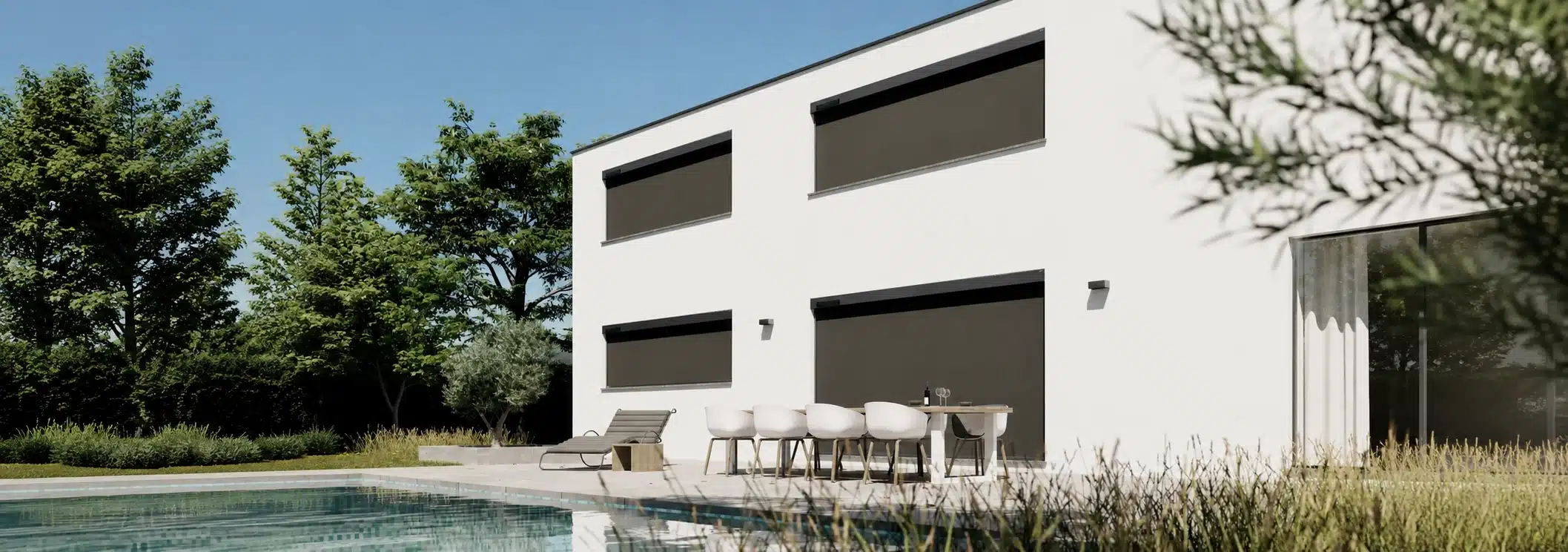
Many homes therefore need more than one solution. A patio awning can provide shade over the patio, while a vertical awning protects windows, balcony doors, or glass panels on, for example, balconies and sunrooms.
Reduce solar heat gain through windows and glass surfaces
A room with large windows can get very hot in the middle of the day, especially if it faces south or west. Therefore, consider the room’s orientation, how long the sun shines on it, and how much heat enters through the glass.
Dim bright lights in the rooms where you spend time indoors
In living rooms, bedrooms, and home offices, direct sunlight can make it uncomfortable to read, work, or look at a screen. In such cases, the sunshade needs to reduce glare without necessarily blocking out all daylight.
Create more privacy where overlooking is a problem
On balconies and near large windows, you may need both sun protection and a greater sense of privacy. In that case, it’s important to assess where overlooking from outside is coming from and how much natural light and view you still want to maintain.
Protect the surface where you sit outdoors
On decks and patios, the problem is often that the sun is directly above the seating area. In that case, you need to consider the size of the area, the sun’s direction throughout the day, and the facade’s suitability for installation.
What type of sun protection is best for windows, decks, and balconies?
For patios and decks, a patio awning is often the best choice when you want to provide shade over a larger area. For windows, sunrooms, and glass-enclosed balconies, a vertical awning is often more suitable because the sunshade is positioned close to the glass and can reduce heat and glare.
When comparing sunshades, you should therefore start with the location and the problem you want to solve, not with a specific model.
| Location | Common problem | A solution that often works |
|---|---|---|
| Deck / Terrace | Too much direct sunlight on the seating area | Terrace awning |
| Windows facing south or west | Indoor heat and glare | Vertical awning |
| Balcony | Sunlight, privacy, and limited space | Vertical awning or a smaller awning |
| Glazed balcony | Glass partitions heat up quickly | Vertical awning or zip screen |
| Outdoor living space | High heat due to large glass surfaces | Exterior vertical sunshade |
| Bedroom / living room | Light, Heat, and glare | External shading, complemented by internal shading if needed |
The table is a simplified guide, but the principle is important: a patio often needs shade over a large area, while a window or glass wall needs protection close to the glass. That’s why patio awning and vertical awning are good for different things.
What types of sun protection are available, and what are they used for?
There are both exterior and interior sunshades. Patio awning are primarily suitable for patios, vertical awning for windows and glass walls, while, for example, venetian blinds and roller shades are primarily used for light control, blackout, and privacy indoors.
- Terrace awning
- A retractable awning for patios, terraces and outdoor seating areas. The awning is fixed to the façade and extends over the seating area. It is particularly suitable for providing shade over a larger outdoor space.
- Vertical awning
- An exterior sunshade for windows, balcony doors, glass-enclosed balconies, and sunrooms. It is mounted vertically in front of the glass and is ideal when you want to reduce heat, glare, or views in from outside.
- Drop-arm awning
- A small window awning often seen on older houses. It can be a good choice if you want a more traditional look, but it doesn't always provide the same protection against the sun's heat as a vertical exterior sunshade.
- Shade sail
- A simpler solution that is stretched between several attachment points. A shade sail can provide shade over a small seating area or part of the garden, but requires more manual effort than an awning.
- Pergola or fixed roof
- A more permanent solution for the patio that can create a distinct sense of space and a larger sheltered area. At the same time, it is a larger project than a retractable awning.
- Venetian blinds, roller blinds, curtains, and pleated shades
- Interior sunshades that are well-suited for blackout, light control, and privacy. If the main problem is heat coming through the window, an exterior sunshade often makes a bigger difference.
- Window Film
- Installed directly on the glass, it can reduce glare and some solar heat. It can be an option in places where an external sunshade cannot or is not allowed to be installed.
When is " vertical awning " a good choice for window solar shading?
A vertical awning is particularly well-suited when south- or west-facing windows make the room hot or cause glare. Since the sunshade is mounted on the outside, it blocks the sun’s rays before they reach the glass, which makes vertical awnings ideal for standard windows, large glass panels, and sunrooms alike.
Reduces heat
The sun's rays are blocked before they reach the glass and have a chance to heat up the room. This is especially important if blinds or roller blinds are already in use but the temperature still gets too high.
Reduces glare
Less direct sunlight can create a more pleasant lighting environment in living rooms, bedrooms, and home offices, especially where the sun shines for several hours.
Reduces overlooking
With the right fabric, a vertical awning can provide more privacy without blocking out all the daylight. At the same time, the view can still be partially seen through the fabric.
When is a patio awning a good choice for providing shade on a deck or patio?
A patio awning is particularly well-suited when you want to create a shaded area where you can sit, eat, and socialize. It extends over the deck or terrace and is most useful when the sun is directly overhead the part of the outdoor space that’s in use.
A patio awning is mounted on the façade and can be adjusted to fit the width of your patio and the size of the area you want to shade. Keep in mind that the shadow moves throughout the day—so the direction of the sun affects when the shade is needed most.
The greatest need is in the middle of the day
A south-facing patio often gets strong sunlight when the sun is high in the sky. This is where a patio awning comes in especially handy when you want to be able to use the seating area during lunch and in the middle of the day.
Greatest need later in the day
A west-facing patio often gets lower sun in the afternoon and evening. In that case, the awning needs to provide shade when the sun comes in from the side and would otherwise shine directly on the seating area.
What type of sun protection is best for a balcony and a glass-enclosed balcony?
A vertical awning is often a good fit for balconies where sunlight, heat, overlooking, and limited space all need to be managed at the same time. On a glazed balcony, this need is particularly evident when the sun heats up the glass panels during the day.
Skugga, insyn och begränsat utrymme
On an open balcony, a sunshade can make the space more usable during the day. A vertical awning is particularly well-suited for areas where the sun shines from the side or where you want to block the view from the outside without taking up much space on the balcony.
The heat behind the glass is the most important factor
On a glass-enclosed balcony, large glass surfaces can cause heat to build up quickly inside the glass, especially on south- and west-facing sides. In such cases, an exterior sunshade is useful because it blocks the sun’s rays before they reach the glass panels.
What is the difference between external and internal solar shading?
Exterior sunshades usually make the biggest difference when the problem is heat, since they block the sun’s rays before the glass and the room have time to heat up. Interior sunshades are better suited for blackout, privacy, and light control, and are a simpler solution when the façade must not be altered.
For many homes, a combination works best: exterior sun protection against heat and interior sun protection for blackout, privacy in the evening, and additional light control.
| Needs | External solar shading | Internal sun shading |
|---|---|---|
| Reduce heat | Very good | Limited |
| Reduce glare | Good | Good |
| Black out a room | Varies depending on the fabric | Very good |
| Reduce overlooking | Effective with the right fabric | Very good |
| Affects the building façade | Yes | No |
| Examples | Patio awning, vertical awning, screen | Venetian blinds, roller blinds, curtains, pleated shades |
What should you consider before choosing sun protection?
Once you know what type of sunshade is right for the location, there are a few practical choices left to make. These don’t determine which solution you need, but they do affect how well the sunshade works in everyday use and how it complements the house.
- Operation
-
A motor is convenient for larger awnings or solutions that are used frequently. crank handle may be suitable for smaller patio awnings or locations where you want to avoid an electrical connection.
Solar power can be practical in places where it is difficult to run permanent electrical wiring, such as on an existing facade or balcony. LEDs are primarily a convenience choice for outdoor spaces in the evening.
- Colour and Fabric
-
The choice of colour affects how the sunshade appears on the facade. A dark profile can complement modern homes with black or grey details, while lighter profiles often blend in better with classic facades.
A screen fabric from a vertical awning can block out the sun and prevent people from seeing inside without making the room completely dark.
- Planning permission and regulations
-
Regulations for awnings and other exterior sunshades vary depending on the location, the building, and how the installation affects the facade. Therefore, check the current guidelines from your local authority or the relevant building regulations authority and find out if there are any local regulations or specific requirements that affect the planned installation.
If you live in an flat or a multi-family building, you also need to check whether the installation requires approval from the property owner, property manager, homeowners’ association, or another responsible party before installing an exterior sunshade.
- Maintenance
-
Brush off leaves and dirt, and wash gently with mild soap as needed. Retract the patio awning in strong winds, heavy rain, and snowfall.
An awning is primarily a sunshade, not a permanent shelter for all weather conditions.
How do you choose the right sun protection for windows, decks, and balconies?
Start by identifying where the sun is the most bothersome. Is it the room behind the window, the patio itself, the balcony, or the sunroom? Then decide based on what you want to address in that specific spot.
Check these five points
-
Choose patio awning when your patio needs shade
Patio awning Perfect for when you want to create shade over your balcony, patio, or deck and protect the area where you sit, eat, or socialize.
-
Choose a vertical awning when you want to shade the glazing
A vertical awning is ideal for windows, balcony doors, sunrooms, and enclosed balconies where you want to reduce heat, glare, or overlooking.
-
Add an interior sunshade if needed
Venetian blinds, roller blinds, curtains or pleated blinds can be useful additions when you want to darken a room, improve privacy in the evening or control indoor light more precisely.
-
Compare other solutions if the location requires it
Sun shades, pergolas, and window film may be relevant options when comparing different types of solar shading. They are not part of Balustradedesign’s product line, but they help clarify the difference between various solutions.
-
Check the rules before you order
Check the applicable regulations before installing an exterior sunshade, especially in apartment buildings or if the building is located in a historic district or other setting where the façade may be subject to special requirements. Also find out whether the installation requires approval from the property owner, property manager, homeowners’ association, or another responsible party.
Choose a patio awning when you want to shade a patio, and a vertical awning when you want to protect windows or glass surfaces. Interior sun protection works best as a complement to blackout, privacy, and additional light control.
Which sunshade is best suited for your location?
Start by identifying where the sun causes the most disruption and whether you primarily want to reduce heat, glare, or create shade. Customer service helps you compare solutions, dimensions, and control options before making your choice.
What do you need to know about sun protection for windows, decks, and balconies?
The most common questions concern heating, the choice between patio awning and vertical awning, balconies, and which regulations might affect installation. Here are brief answers to some of them.
Which type of sun protection is best for reducing heat?
Exterior sunshades are usually the best way to combat heat because they block the sun before the glass and the room have a chance to heat up. For windows, sunrooms, and enclosed balconies, a vertical awning is often a good choice.
Which is better: patio awning or vertical awning?
It depends on the location. Patio awning is best when you want to create shade over a patio, terrace, or outdoor seating area. Vertical awning is better suited when you want to protect windows, balcony doors, or other glass surfaces from the sun and heat.
What type of sunshade is best for a balcony?
A vertical awning is often a good fit because it’s mounted close to the facade and doesn’t take up floor space. On a glass-enclosed balcony, it can also reduce the amount of sunlight hitting the glass panels. In apartment buildings, you’ll need to check the applicable rules before installing the sunshade and determine whether approval is required from the property owner, property manager, homeowners’ association, or another responsible party.
Are blinds or roller blinds enough for sun protection?
Venetian blinds and roller blinds work well for light control, privacy, and blackout. If the main issue is heat coming through the glass, an exterior sunshade is often a better solution because it blocks the sun’s rays before they reach the glass.
What is the best sun protection for a sunroom?
Exterior sunshades are often the best option when the goal is to reduce the heat in a sunroom. A vertical awning or a screen solution can block the sun before large glass panels have a chance to heat up the space.
Do I need planning permission for an awning?
It depends on the building’s location, how the awning is installed, and how the facade is affected. Regulations vary by country and region. Therefore, check the requirements that apply to the building before ordering or installing the awning. In multi-family buildings, you may also need approval from the property owner, property manager, homeowners’ association, or other responsible party.
Does Balustradedesign sell sunshades, pergolas, or window film?
No. Balustradedesign does not sell sun sails, pergolas, window film, blinds, roller shades, or pleated shades. They are mentioned in the article because they are common options when comparing different types of solar shading. The product line focuses on custom-made patio awnings and vertical awnings.