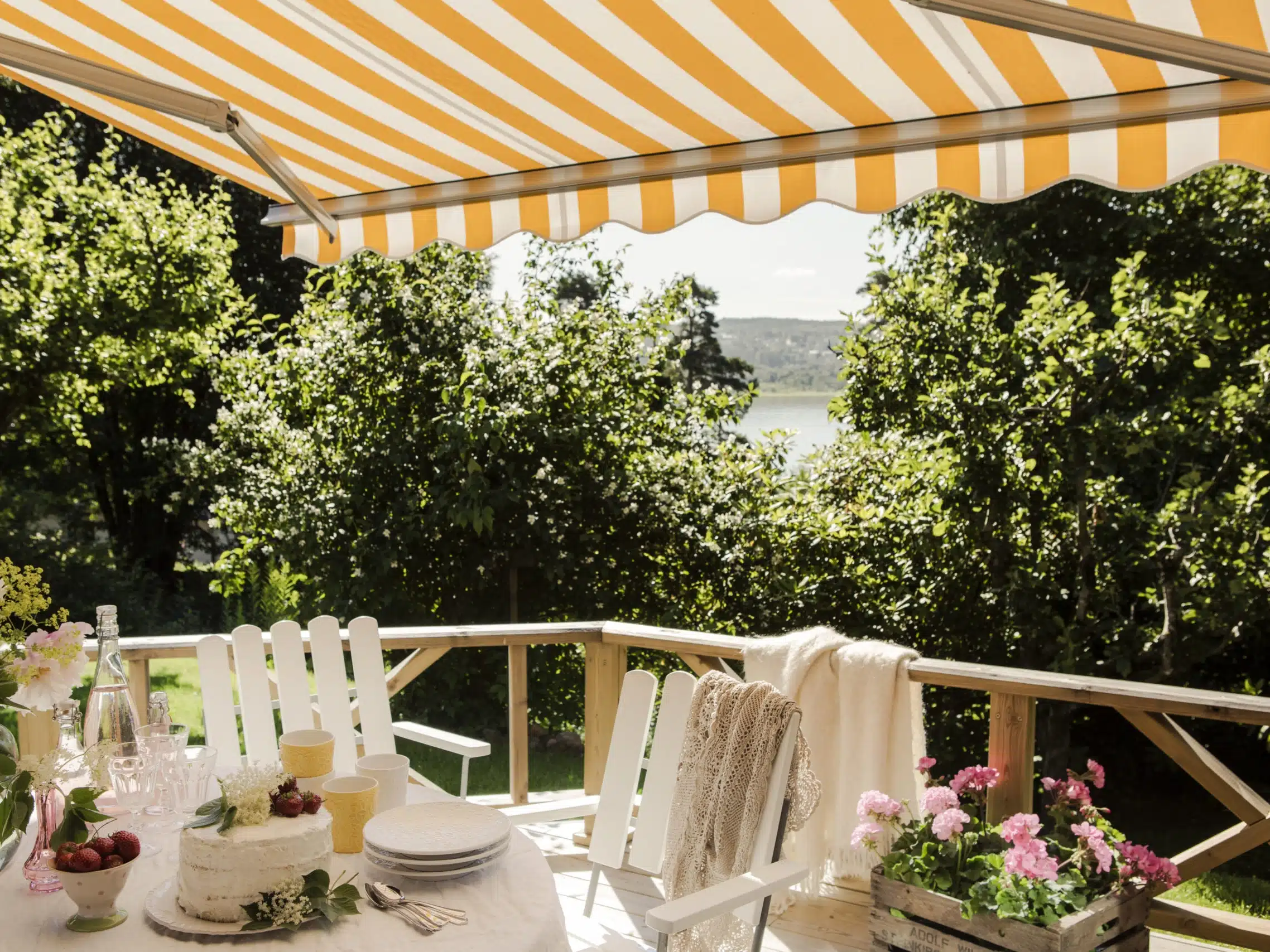
The right awning for your patio is chosen based on where the sun comes from, which area you want to shade, how the awning can be mounted, and how you want to use it. Compass direction, width, and projection are therefore more important than simply basing your choice on the patio’s total size.
A patio awning provides flexible shade without permanently enclosing the patio. When the sun isn’t a problem, the awning can be retracted, and the right placement can make both the seating area and the rooms inside the facade more comfortable on sunny days.
In this article, we’ll go over how orientation, size, fixing, motor or crank handle, and other practical considerations affect which awning is the best fit for your patio before you place your order.
What do you need your patio awning to do?
If strong midday sun is the main problem, a patio awning over the seating area often works well. If sunlight comes from low at the side, you want to reduce overlooking, or you need shade in front of a window, you may need to adapt or supplement the solution.
| Needs | What matters | Common solution |
|---|---|---|
| Shade at midday | The sun is high in the sky | Retractable awning over the patio |
| Shade in the late afternoon | The sun is low in the sky and shining from the side | Awning supplemented by a vertical awning |
| Cooler indoors | The sun warms the room through the windows | Awning providing shade for the façade |
| More privacy | Overlooking from the side | Side screen or vertical awning |
| Protection against light rain | Possible, but limited | Awning with a sufficient slope |
The awning doesn't always have to cover the entire patio. Often, it's enough to size the shade to fit the seating area and the part of the patio that is actually used when the sun is at its strongest.
How does the direction you're facing affect which awning you should choose?
The compass direction primarily determines when the sun hits the patio and at what angle. On a south-facing patio, the sun is often high in the sky, while low afternoon and evening sun from the west may require additional side sun protection.
- South-facing
- Here, the sun is often high in the sky for much of the day. A patio awning with the right projection can therefore provide effective shade over the seating area when the sun is at its strongest.
- West-facing
- The low afternoon and evening sun can reach beneath the awning from the side. The patio awning may therefore need to be complemented by a vertical awning to provide shading from that direction.
- East-facing
- This is when the sun is at its strongest earlier in the day. How much sun protection is needed therefore depends on when the patio is used and whether the morning and early afternoon sun is actually a problem.
- North-facing
- Direct sunlight is usually less intense than on south- and west-facing patios. The need for an awning may therefore depend to a greater extent on the season, the time of day, and the patio’s location in relation to the building.
How does the position of the awning affect the fixings?
The location primarily affects fixing. The awning itself may be the same, but a patio adjacent to the façade, a freestanding seating area in the garden, and a raised patio create different conditions for how awning can be installed.
The key factor is whether there is a load-bearing facade to which the awning can be attached or whether the solution requires support legs or a freestanding structure.

Start by deciding where to place awning
If the patio is directly adjacent to the house, the awning is normally attached to the facade. The fixings must be adapted based on the wall’s construction material and the location of the load-bearing structure.
If there is no facade to attach it to, support legs or a freestanding structure capable of supporting the awning are needed.
If the patio adjoins the house, the fixings must be anchored to the load-bearing structure behind the façade. The cladding alone must not support the awning.
The substrate determines how the awning can be installed. Wooden facades, stucco over insulation, and masonry materials require different fixing, so check the facade’s construction before placing your order.
What affects the cost of a patio awning?
Width and drop have the greatest impact on price, since they determine both material usage and how sturdy the construction needs to be. Other factors that influence the price include the motor or crank handle, the fabric, and the model selected.
The available features and options depend on the specific model. Therefore, compare the options offered for the awning you are viewing.
The price of a patio awning therefore varies significantly depending on the area you actually want to shade and the features you choose. The most accurate way to determine the price is to base it on the measurements of your own patio.
The wider and deeper the awning, the more material is needed and the greater the demands placed on the structure.
Motor makes awning easier to use on a regular basis, while crank handle is a simpler alternative with fewer features.
The fabric, model, and other product choices affect both the price and how the awning functions and is experienced on the patio.
Start with the seating area and the space you actually want to shade, rather than automatically sizing the awning based on the entire width of the patio.
What should you check before ordering an awning?
Check the direction of the sun, the façade material, which surface is to be shaded, the width and projection, how the awning is to be operated, and that there is sufficient clearance at the façade.
Review these six points
-
Check when the sun is a problem
Note at what time of day the sun becomes a nuisance and from which direction it comes. This affects both the awning's projection and whether you need additional solar shading from the side.
-
Check the exterior cladding material
Find out how the facade is constructed where the awning will be installed. The fixings must be suited to the substrate and the load-bearing structure behind the facade.
-
Measure the area you actually want to shade
Start with the seating area or the part of the patio that gets the most sun. The awning doesn't necessarily have to cover the entire patio.
-
Determine the width and projection
Adjust the dimensions based on the location of the seating area and the angle of the sun. The width determines how much area is covered sideways, and the projection determines how far the awning can extend from the facade to provide shade.
-
Select an engine or crank handle
Think about how often awning will be used. A motor makes it easier to open and close it frequently, while crank handle is a simpler option.
-
Check the clearance
Make sure that the awning can be installed at a sufficient height and that it does not interfere with, for example, doors, windows, and lighting when it is extended.
When the sun's position, fixing, and the desired shaded area are carefully considered, it becomes much easier to choose the right size and design at awning.
Which awning is the best fit for your patio?
Take into account the orientation, the shaded area, and the conditions of the facade. Customer service will be happy to help you find the right solution.
What should you know about awnings for patios?
Here are brief answers to frequently asked questions about size, western sun, rain, price, installation, and planning permission for an awning.
What size awning do I need for my patio?
Start with the area you actually want to shade—usually the seating area— rather than the entire patio. The width and projection then need to be adjusted based on the sun’s direction and the seating area’s location.
Can you install an awning over a patio away from the house?
Yes, but in that case, a solution with support legs or a freestanding structure is needed, since there is no façade to attach the awning to.
Does a patio awning work against the setting sun?
Partially. The afternoon and evening sun is low in the sky and can shine in under the awning. Therefore, the patio awning may need to be supplemented with sunshades that block the sun from the side.
Can a patio awning withstand rain?
Light rain is not a problem if the awning has sufficient slope so that the water can run off. In case of heavy rain or strong winds, awning should be retracted.
How much does a patio awning cost?
The price is primarily influenced by width and drop, and then by factors such as the motor or crank handle, fabric, and model. Therefore, start by considering the size and features you actually need.
Do I need planning permission for an awning?
It depends on the awning's design, location, and how it affects the building. Larger structures and special circumstances may affect the assessment, so check what applies to the property before installing the awning.